

What If They Never Lost Motivation?
“Nothing works for me.”
As a dietitian, I’ve heard those four words more times than I can count.
If I had a dollar for every time someone said them, I’d probably have enough money to buy one of those overpriced detox teas.
Just kidding….I still wouldn’t buy one. Your liver and kidneys already have that job. (This is apparently my favorite rant to discuss!)
But every time I hear those words, I don’t think…
“They’re lazy.”
Or
“They just don’t want it badly enough.”
I usually find myself wondering something completely different.
How many times have they already tried?
Because what if years of dieting don’t just change our waistlines?
What if they change the way we think?
How I Started Wondering About Learned Helplessness and Obesity
Some of my favorite blog ideas don’t come from reading research papers.
They come from conversations.
A colleague and friend of mine recently mentioned something called learned helplessness and wondered if it could play a role in obesity.
She was convinced.
My first thought?
“What in the world is learned helplessness?”
But she sparked my curiosity. And once my curiosity gets going…Well…my wife will tell you there isn’t much stopping it.
So I started reading. Then I kept reading.
Then I looked up and realized I somehow had thirty browser tabs open and had completely forgotten what I originally sat down to do.
(Please tell me I’m not the only one who does that.)
Here’s what surprised me.
There’s decades of research on learned helplessness.
Decades on weight stigma.
Decades on self-efficacy.
Decades on metabolic adaptation.
Decades on repeated dieting.
But very little research has tried putting those pieces together.
That doesn’t mean they’re connected.
It simply means we don’t know yet.
And honestly…
I think that’s where the most interesting questions live.
Before I go any further, I want to be clear.
Everything I’m about to discuss about learned helplessness, self-efficacy, attribution theory, weight stigma, and internalized weight bias comes from established psychological research.
The connection I’m making between those concepts and obesity is my own interpretation after reading the literature.
I’m not claiming it’s been proven.
I’m simply asking a question I think deserves to be studied.
Then It Got Personal
The more I read…The more uncomfortable I became.
Because I wasn’t just reading about my patients anymore……I was reading about myself.
Growing up, I struggled with body image.
Maybe you had cousins like mine.
The ones who could seemingly eat whatever they wanted and never gain a pound.
Meanwhile, I was constantly aware of my own body.
Constantly comparing.
Constantly wondering what was wrong with me.
Truthfully…I still catch myself doing it.
Long before I became a registered dietitian, I was just another kid trying to lose weight.
If there was a diet…I wanted to try it.
If someone promised quick results…I was interested.
If it came in a flashy bottle with words like rapid or extreme…Teenage Chase was sold.
Yep, looking at you Hydroxycut…
Looking back, I wonder how much of my own thinking was shaped by years of dieting…and years of quietly believing I wasn’t enough.
I wasn’t chasing health. I was chasing the feeling that maybe I’d finally be enough.
Those are two very different things.
I was just a kid who thought his body needed fixing.
And I never stopped to ask…
Who convinced me that in the first place?
Maybe that’s why I connect with so many of my patients.
When someone tells me they’ve tried everything… I believe them.
Maybe that’s my own bias. Or maybe it’s empathy. Probably a little of both.
What Is Learned Helplessness?
Psychologist Martin Seligman first described learned helplessness more than fifty years ago.
The idea is surprisingly simple.
When we repeatedly experience situations where our actions don’t seem to change the outcome, something begins to change.
Not our ability. Our expectations.
Instead of thinking,
“Maybe this will work…”
we slowly begin thinking,
“Why bother?”
Psychologists call this an expectancy shift.
Eventually, some people stop trying—not because they’re incapable—but because they’ve stopped believing their efforts matter.
That’s very different from laziness.
Laziness says,
“I don’t want to.”
Learned helplessness says,
“I don’t think it’ll make a difference anyway.”
Those are two completely different mindsets.
And honestly…I see that difference every day in clinic.
It’s Not Just Failure. It’s the Story We Tell Ourselves.
Another concept that caught my attention was attribution theory.
Fancy name. Simple idea.
How do we explain failure to ourselves?
Imagine two people regain weight after following the exact same diet.
One says,
“That diet wasn’t realistic.”
The other says,
“I failed.”
Same outcome. Different story.
One blames the strategy.
The other blames themselves.
Over time…
“That diet didn’t work.”
can quietly become…
“Nothing works.”
That shift matters. Because eventually…
The problem isn’t the diet anymore. The problem becomes how we see ourselves.
Somewhere Around Paper Number Twenty…
Something clicked.
Maybe I wasn’t reading five different psychological theories.
Maybe I was reading five different chapters of the same story.
Not a story that’s already been proven.
A story I couldn’t stop wondering about.
I don’t think obesity itself creates learned helplessness.
I think the experience of living with obesity might.
Years of dieting. Biology pushing back.
Watching the scale stall despite doing everything “right.”
Being told you just need more willpower.
Trying again. Falling short again.
Research has shown that people who repeatedly attempt to lose weight often have a harder time succeeding in the future.
Some researchers think those repeated disappointments may slowly chip away at optimism, confidence, and the belief that future efforts will be different.
That made me stop.
If your brain has lived through all of that…what does it learn?
Repeated effort.
Repeated disappointment.
Repeated setbacks.
Eventually…Does it stop expecting success?
I don’t know. But I think it’s a fair question.
And that’s where my curiosity led next.
Not to metabolism.
Not to calories.
But to something far more personal…
The stories we begin telling ourselves.
The Impact of Weight Stigma
As if biology wasn’t frustrating enough…
Society jumps in too.
“You’re lazy.”
“You just need more discipline.”
“Just eat less.”
Most people living with obesity have heard some version of those comments.
Sometimes from strangers.
Sometimes from family.
Sometimes even from healthcare professionals.
Research consistently shows those messages don’t motivate people.
If anything…They often make things worse.
Weight stigma has been linked to higher levels of stress, depression, anxiety, emotional eating, avoiding healthcare, and poorer health behaviors.
In other words…Shame isn’t much of a treatment plan.
But as I kept reading, I started wondering if weight stigma was only half the story.
Because what happens when those voices stop coming from other people……and start coming from ourselves?
When Other People’s Voices Become Your Own
One concept kept pulling me back. Internalized weight bias.
Here’s the difference.
Weight stigma is what happens to us.
Internalized weight bias is what happens inside us.
It’s the moment when…
“You’re lazy.”
becomes…
“Maybe I really am lazy.”
Or….
“You just need more willpower.”
becomes…
“Maybe I’m just not disciplined enough.”
The label stops feeling temporary. It starts feeling like your identity.
If I’m honest…That one hit me.
Because I can remember times I wasn’t just fighting the scale. I was fighting the story I’d started telling myself.
There were days I’d look in the mirror and say things to myself that I’d never dream of saying to another person.
Looking back, that’s what makes me sad.
Not because I struggled with my weight…
But because I genuinely believed my worth depended on changing my body.
Moments like that remind me why weight management has never been just about calories in versus calories out.
Calories matter.
Biology matters.
Psychology matters too. Maybe more than we sometimes realize.
Confidence Changes Everything
Research has consistently shown that people with higher levels of internalized weight bias (what we tell ourselves) tend to have lower self-esteem, more depression and anxiety, poorer body image, more emotional eating, and less confidence in their ability to make healthy changes.
That last part jumped off the page…..Less confidence.
Because confidence is the foundation of self-efficacy —our belief that we can influence our own outcomes.
Then something else hit me.
Maybe learned helplessness doesn’t begin the day someone gives up.
Maybe it begins years earlier.
Maybe it starts the first time a child believes they’re broken.
Maybe it grows every time another diet fails.
Every time biology pushes back.
Every time someone says,
“You just need more willpower.”
Until one day…
“Maybe this diet won’t work.”
quietly becomes…
“Maybe I won’t work.”
I haven’t found research proving that’s what happens.
But I also can’t stop wondering if this is one of the psychological pathways that eventually leads some people toward learned helplessness.
Maybe that’s why this idea has stayed with me.
We often talk about obesity as if it’s simply a matter of choices.
But what if, for some people, it’s also the story they’ve slowly been taught to believe about themselves?
Obesity isn’t a failure of character.
It’s not proof that someone is lazy.
It’s not proof they don’t care.
It’s not proof they haven’t tried.
For some people, years of stigma, repeated setbacks, and believing they’re the problem simply become part of their story.
And that’s exactly why I think these psychological theories deserve more attention.
One Study I Couldn’t Stop Thinking About
One study followed more than 2,000 girls from age 10 to age 19.
Researchers asked one simple question:
“Has anyone ever told you that you’re too fat?”
A parent.
A sibling.
A teacher.
A friend.
Years later, the girls who had been labeled “too fat” had higher odds of having obesity, even after researchers accounted for how much they weighed at the beginning of the study.
Let’s be careful here. This doesn’t prove those comments caused obesity.
That’s not what the study showed.
But it does remind us that words matter.
Especially the ones children hear over and over again.
And maybe even more importantly…The words they eventually begin saying to themselves.
If you’re a parent, this study stopped me in my tracks.
It reminded me that children often believe the stories we tell them—especially the ones we repeat.
The way we talk about our own bodies matters.
The way we talk about our children’s bodies matters even more.
Self-Efficacy: The Missing Piece?
Psychologist Albert Bandura described self-efficacy as our belief that we can succeed.
Think about learning to ride a bike.
The first time you stay upright for more than a few seconds…
Your confidence grows.
Then you make it to the end of the block.
Your confidence grows again.
Success builds confidence.
Confidence makes you more willing to try again.
Now flip that around.
Imagine repeated setbacks.
Repeated disappointment.
Repeatedly feeling like your effort doesn’t match your results.
Confidence slowly starts disappearing.
That’s why I wonder if successful obesity treatment isn’t just about helping people lose weight.
Maybe it’s also about helping people believe they can succeed again.
Because confidence changes behavior.
Behavior creates success.
Success builds confidence.
It’s the exact opposite direction of learned helplessness.
One Thing I’ve Noticed in Clinic
This is simply an observation.
It’s not research. It’s not proof.
It’s just something I’ve noticed caring for patients.
I’ve watched many people start GLP-1 medications.
Yes, they lose weight.
But that’s not the biggest change I’ve noticed.
It’s hope.
People smile more.
They seem lighter long before they’ve lost much weight.
For the first time in years, they aren’t fighting relentless hunger every waking minute.
Healthy choices suddenly feel achievable.
It’s as if, for the first time in years, success feels possible again.
I can’t prove that’s reversing learned helplessness and I’m not suggesting the research says that.
But I also can’t ignore what I’m seeing.
Sometimes success seems to restore something years of failed dieting slowly chipped away.
Confidence.
Hope.
A belief that their efforts actually matter again.
Maybe that’s what I’ve been witnessing all along.
Not just weight loss.
Hope returning.
And that brings me back to the question that started this whole rabbit hole…
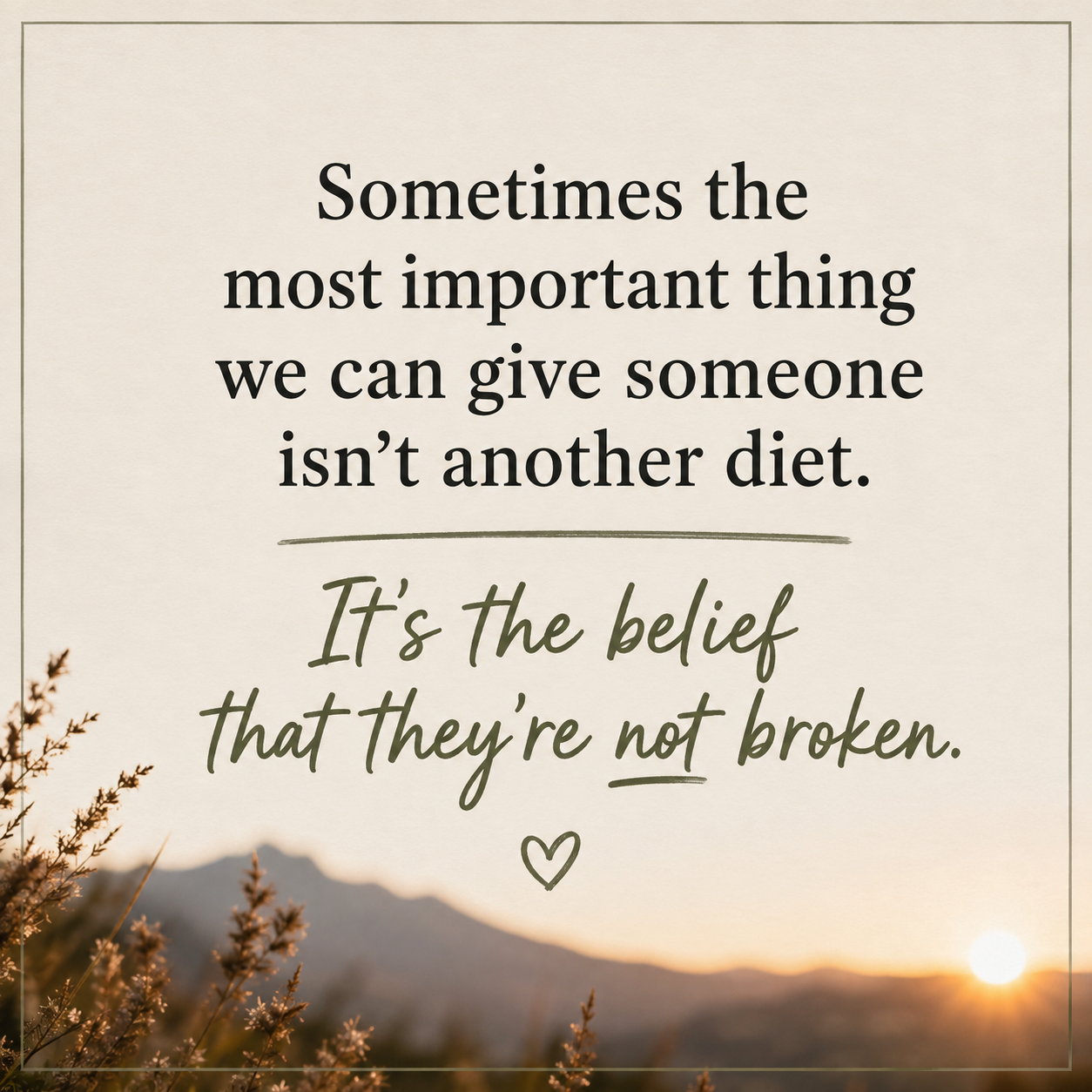
What if people living with obesity never lost motivation in the first place?
After reading the research, I don’t think the answer is as simple as yes or no, but totally leaning towards yes.
I think many people want to change just as much as they always have.
What’s changed may not be their motivation.
What’s changed may be their belief that their effort will actually make a difference.
Years of failed diets.
Biology pushing back.
Weight stigma.
Internalized weight bias.
Repeated disappointment.
Those experiences can slowly teach someone that trying won’t change the outcome.
And when you stop believing your effort matters…Motivation starts to look an awful lot like it’s gone.
Maybe it never disappeared at all.
Maybe it was buried underneath years of believing success was no longer possible.
The next time someone tells me,
“Nothing works anymore,”
I’m not going to assume they lost motivation.
I’m going to wonder what happened long before they walked into my office.
Maybe it was another failed diet.
Another comment about their weight.
Another doctor’s appointment where they felt judged instead of understood.
Another family member who thought shame would be motivating.
Another promise that this diet would finally be the one.
How much time did I spend believing that if I could just find the right plan, the right supplement, or somehow muster enough willpower, everything would finally fall into place?
The truth is…I wasn’t chasing health.
I was chasing the feeling that maybe I’d finally be enough.
Those aren’t the same thing.
And I have a feeling I’m not the only one.
Maybe the biggest barrier to losing weight isn’t that people have stopped trying.
Maybe they just stopped believing their effort could change the outcome.
If that’s true, then our job as healthcare professionals is about more than meal plans, medications, or telling someone to “try harder.”
Maybe our first job is helping people believe they’re capable of succeeding again.
Helping them rebuild confidence.
Helping them rebuild hope.
Because hope changes things.
It’s what gets someone to schedule another appointment.
To lace up their shoes for another walk.
To cook one more healthy meal.
To believe tomorrow can be different from today.
I don’t know if learned helplessness belongs in the conversation about obesity.
But after reading the research, I think it deserves a seat at the table.
Not because we’ve proven the answer…But because it’s helping us ask better questions.
Questions that move us away from blame…and toward understanding.
Because if years of dieting, biology, and weight stigma can slowly chip away at hope…
Maybe motivation isn’t the first thing people lose.
Maybe belief is.
Maybe they never lost motivation.
Maybe they lost the belief that their motivation would make a difference.
Because obesity was never a failure of character.
And maybe treatment shouldn’t begin with judgment.
Maybe it should begin rebuilding hope.