

When “Eat Real Food” Turns Into Fat Shaming: Why the Mike Tyson Commercial (and the MAHA Health Agenda) Miss the Point
Let’s not tiptoe around this.
The Mike Tyson “Eat Real Food” Super Bowl commercial didn’t truly promote nutrition — it leans on fat shaming as its emotional engine.
The tone is aggressive (watch here).
The imagery is punitive and it was honestly a horrible commercial to put forth.
And the language used by Mike Tyson repeatedly frames being fat as weak, undisciplined, and embarrassing.
Throughout the commercial, Tyson talks about Americans being “fat,” “soft,” and out of control — portraying larger bodies as proof of moral failure and personal decay.

He states:
“I was so fat and nasty”
“We have the most obese fudgy people”
The message is loud and clear: If you’re unhealthy, it’s because you didn’t try hard enough.
That’s not motivation.
That’s stigma.
And stigma has never improved population health.
Let me be clear: obesity is not a personal flaw or the result of one bad habit. It reflects systems that influence income, access, stress, healthcare, and environment. Processed foods matter — but social determinants of health matter more.
Why the commercial feels gross — and why it matters to public health
Fat shaming is often defended as “tough love,” but decades of research tell a different story.
Weight-stigmatizing messages:
increase stress hormones like cortisol
worsens mental health
linked to disordered eating behaviors
push people away from healthcare
and are associated with higher mortality risk, independent of body size
Shame does not inspire sustainable change.
It triggers stress, avoidance, and disengagement.
So when a Super Bowl ad — amplified by political figures like Robert F. Kennedy Jr. — uses fatness as a warning sign or punchline, it’s not bold or honest.
It’s outdated science packaged as personal responsibility.
Let’s explain what actually drives health
What are social determinants of health?
Because this is the part the commercial — and the MAHA-style health agenda — completely ignores.
Social determinants of health are the conditions in which people are born, grow, live, work, and age. They shape health outcomes far more than individual willpower ever could.
In real life, this includes:
access to affordable, nutritious food
income and job stability
education and health literacy
healthcare access and quality
neighborhood safety and walkability
time availability and chronic stress
social support and community resources
Translation: Health is not just about choices. It’s about what choices are realistically available.
Why “eat real food” sounds simple — and why it isn’t
Here’s where the Tyson commercial really collapses under scrutiny.
Telling people to “eat real food” while:
grocery prices continue to rise
ultra-processed foods remain the cheapest calories
many communities lack full-service grocery stores
people work multiple jobs with limited time
stress levels are chronically high
preventive healthcare is inconsistent
…is not empowering.
It quietly shifts blame back onto individuals and says:
The solution was obvious. You just failed.
That framing doesn’t fix health.
It protects broken systems while RFK Jr. builds a personal brand.
This looks less like public health reform and more like a campaign poster. Dramatic lighting. Tough slogan. Minimal policy.
Health isn’t a photo shoot.
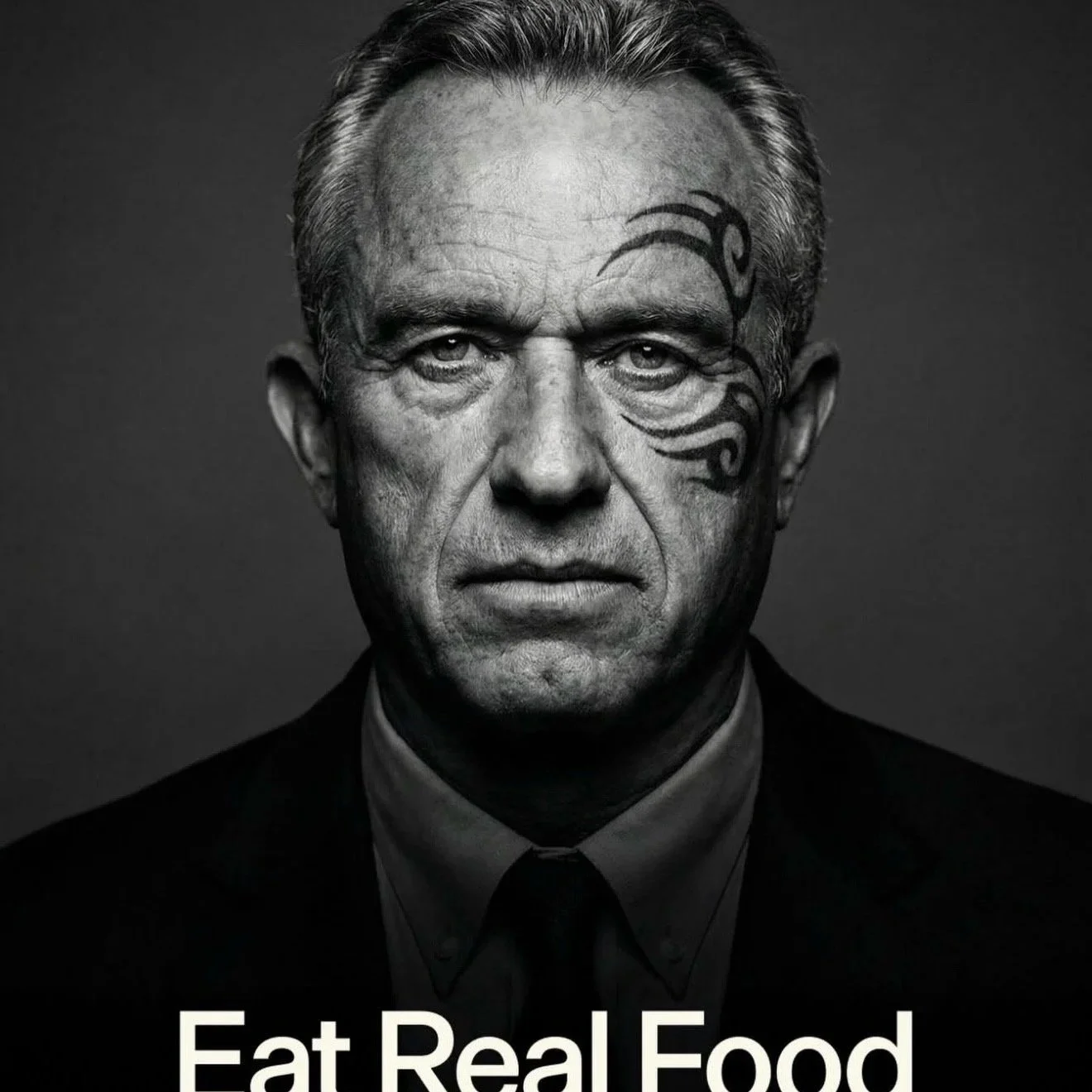
I truly believe RFK Jr. is putting on a performance for all of us to run for president again… I mean look at this picture…Cosplay
Elite athletes are not population-health role models
The commercial leans heavily on Tyson’s identity: discipline, toughness, self-control.
But elite athletes:
have access to trainers, chefs, and medical teams
have schedules built around recovery and health
have financial and time resources most Americans don’t
Using an elite athlete to shame the general population creates a false comparison — one that ignores the structural barriers shaping health in the first place. This is very common in the United States: models, actors, celebrities - we all try to imitate them, but they live VERY different lives than we do.
Same nutrition knowledge. Very different realities.
Two people can know the same nutrition information — and have completely different outcomes because their environments are different.
Scenario 1: A single mom with two kids
She knows the basics:
fruits and vegetables are good
cooking at home is healthier
ultra-processed foods aren’t ideal
But her reality looks like this:
working two jobs with unpredictable hours
limited childcare and little time to cook
a tight food budget stretched across multiple mouths
a grocery store that’s far away, but a convenience store nearby
constant stress and exhaustion
When someone tells her to “just eat real food,” what she hears is:
Do more — with less.
You are the problem
You are not doing enough
When in reality the system is not built with whole health in mind to help her.
Scenario 2: The millionaire/billionaire:
has personal chefs and grocery delivery
can afford fresh foods without thinking twice
has time for exercise, recovery, and sleep
has concierge healthcare and early prevention
lives in a safe, walkable environment
When he hears “eat real food,” it sounds obvious — because for him, it is.
Same nutrition knowledge.
Wildly different outcomes.
This is why public health cannot be reduced to slogans or toughness.
Health isn’t about always knowing or having the right answer. It’s about having the conditions to act on it.
Their message sounds rebellious. It sounds empowering. But functionally, it turns health into a moral test instead of a systems outcome. And public health doesn’t improve by yelling at people to do better while leaving the environment unchanged.
And when health messaging ignores that reality — like the Mike Tyson commercial and RFK Jr.’s MAHA-style approach — it doesn’t motivate people. It blames them.
What the evidence actually shows improves population health
If the goal is lower obesity rates and better health outcomes, the research points upstream — not inward.
What works better than shame:
improving access and affordability of nutritious foods
changing food environments in schools, workplaces, and communities
reducing economic stress and instability
increasing access to preventive care
improving walkability and safe activity spaces
reducing stigma so people engage with healthcare earlier (how many of you are afraid to go to the gym due to feeling judged!? You aren’t alone)
These strategies don’t make for dramatic commercials.
But they produce better, realistic outcomes.
This commercial reduces all these complex health issues to a character judgment — as if your body is proof of your discipline. That’s not evidence-based care. And shame is not policy.
Now Let’s Talk Policy — Because Health Is Built Upstream
If we’re serious about “Make America Healthy Again,” policy has to align with physiology.
And this is where their messaging has consistently missed the mark.
Environmental Protections Are Health Policy
Air pollution is linked to:
Cardiovascular disease
Stroke
Asthma
Lung cancer
Premature death
During this administration, numerous environmental regulations were/are being rolled back or weakened, including:
Emissions standards
Methane regulations
Clean Water Act interpretations
Enforcement oversight
Multiple peer-reviewed analyses projected increased pollution exposure and higher preventable mortality risk associated with weakened standards.
You cannot talk about toxins harming Americans while supporting weaker environmental oversight.
Cleaner air saves lives.
Safer water reduces disease.
That’s epidemiology.
Medicare, Medicaid, and Access to Care
Healthcare access is a social determinant of health.
Medicare and Medicaid cover:
Seniors
People with disabilities
Low-income families
Children
Pregnant women
When funding is reduced, eligibility restricted, or costs shifted:
Preventive care declines
Chronic disease management worsens
Early detection drops
Mortality risk increases
You cannot reduce population-level disease while limiting access to care.
Prevention is cheaper than crisis care.
But it requires funding.
Public Health Infrastructure
Public health includes:
Local health departments
Nutrition assistance programs
Environmental monitoring
Community prevention initiatives
Disease surveillance
When these systems weaken, prevention weakens.
And when prevention weakens, disease increases.
A Super Bowl slogan cannot replace infrastructure.
The MAHA Rhetoric Problem
The MAHA messaging framework often emphasizes:
Discipline
Natural living
Personal responsibility
Distrust of institutions (don’t even get me started on the vaccine debate…)
But improving population health requires:
Strong environmental protections
Stable Medicare and Medicaid funding
Investment in prevention
Food access reform
Infrastructure improvements
Reduced stigma
Health is not a moral ranking system.
Bodies are not evidence of virtue. You can be in a larger body and still be a healthier person.
And discipline is not a substitute for policy alignment.
Chasing Your Health Final Take
Mike Tyson’s commercial sells toughness as health.
RFK Jr.’s MAHA agenda sells discipline as reform and likes to play the celebrity.
But discipline doesn’t fix food access. Shame doesn’t reduce disease risk. You don’t lower disease rates by wishing it was 1965…
If we actually want better health outcomes — not just louder messaging — we need: evidence, compassion, access, and systems-level change.
That’s the lens we’ll keep using at Chasing Your Health.
Facts first. Fear tactics never.