

I’m a man writing about women’s heart health. I’m not pretending to know what it feels like to walk into an ER and not be believed. I’m not pretending to understand what it’s like to have your symptoms minimized.
But I am a husband. I am raising a son. I work in healthcare. And I care deeply about the women in my life — and the women who read this blog.
And the data is clear: Heart disease is the leading cause of death for women. Yet we still talk about it like it’s a “man’s disease.”
That disconnect has consequences.
Heart Attacks in Women Look Different
Most of us were taught the Hollywood version of a heart attack: A man clutches his chest and collapses.
That’s not the full story.
Women often present differently — and that difference is one reason they’re underdiagnosed.
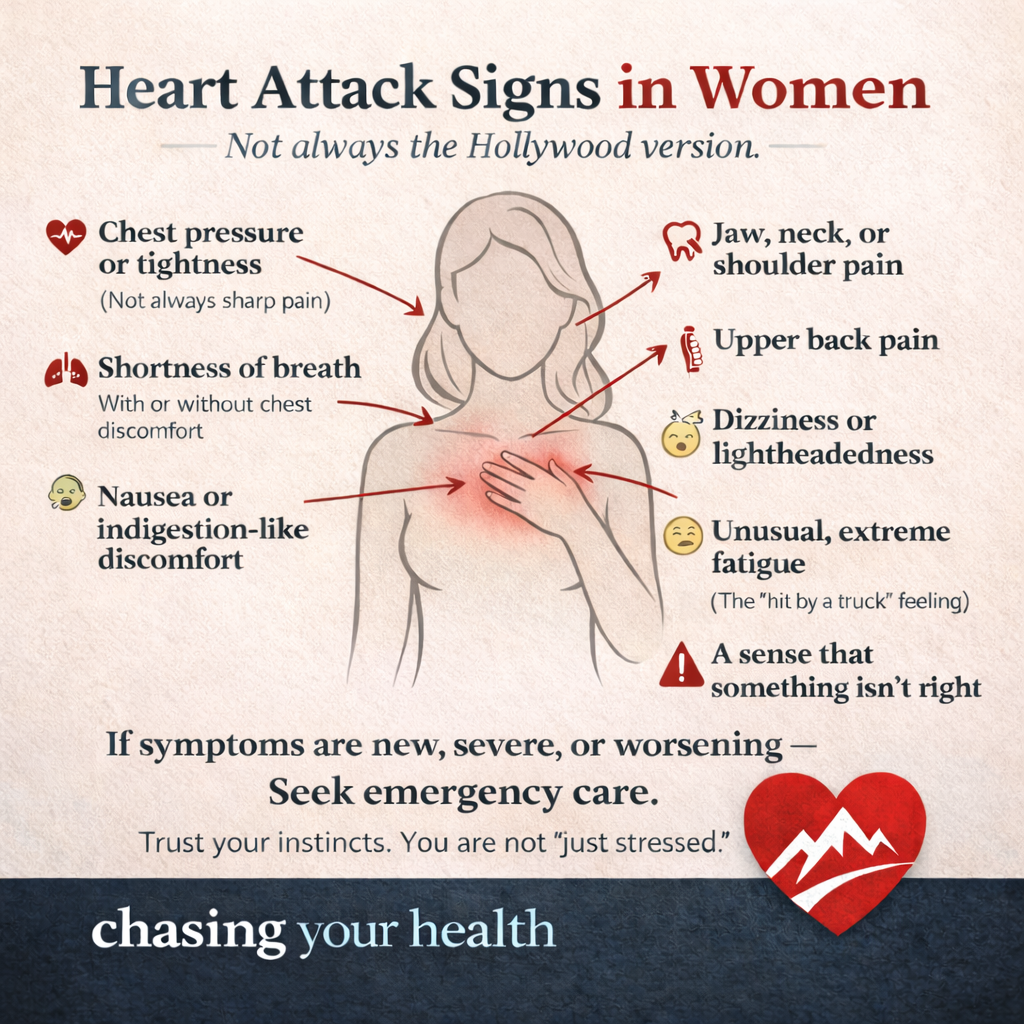
Common heart attack symptoms in women include:
Shortness of breath
Jaw, neck, shoulder, or upper back pain
Nausea or indigestion-like discomfort
Extreme fatigue (the “hit by a truck” kind)
Dizziness
A sense that something just isn’t right
Chest pain can still happen — but it’s often described as pressure, tightness, or burning rather than sharp, crushing pain.
When symptoms don’t match the male-centered “classic” presentation, women are more likely to hear:
“It’s probably anxiety.”
“You’re stressed.”
“Let’s monitor it.”
“You’re just hormonal.”
“You’re too young for heart issues.”
Let’s say the quiet part out loud: Women are still being told their cardiac symptoms are mood swings.
And that’s not just frustrating — it’s dangerous.
Because while someone is being reassured, their heart does not care about the reassurance.
Delays in diagnosis matter.
Women are more likely to experience:
Longer time to treatment
Less aggressive intervention
Higher complication rates
Worse outcomes
Women are also more likely to experience microvascular disease — dysfunction in the small vessels of the heart — which doesn’t always show up on a standard angiogram. So when tests come back “normal,” symptoms can be dismissed instead of investigated further.
Complex physiology does not mean imaginary symptoms.
It means we need better listening.
If the system is built around a male symptom model, women will continue to fall through the cracks.
In Cardiology, falling through the cracks is life and death.
Women Have Historically Been Understudied
For decades, cardiovascular research centered primarily on men. Results were assumed to apply to women.
They don’t always.
Hormonal shifts across the lifespan, pregnancy history, menopause, autoimmune disease prevalence, and inflammatory differences all influence cardiovascular risk.
Women weren’t just underdiagnosed — they were underrepresented in the very trials that shaped treatment guidelines.
And the disparities deepen for women of color.
Black women, for example, have higher rates of hypertension and pregnancy-related cardiovascular complications. Structural inequities, chronic stress exposure, reduced access to preventive care, and implicit bias compound risk.
This isn’t about individual failure.
It’s about systems that weren’t designed with all women in mind.
Stress, Caregiving, and the Invisible Load
Here’s something I see clinically and personally:
Many women carry the invisible load.
Work.
Family logistics.
Caregiving for children or aging parents.
Emotional coordination for everyone in the room.
Chronic stress isn’t just mental — it’s physiological.
Prolonged elevation of cortisol can contribute to:
Elevated blood pressure
Increased inflammation
Impaired sleep
Blood sugar dysregulation
Greater cardiovascular strain
And yet, when women present with symptoms, they’re often told:
“It’s just stress.”
Stress can contribute to heart disease.
It does not explain away persistent chest pressure, radiating pain, or crushing fatigue.
Telling women to “reduce stress” without acknowledging the structural and cultural expectations placed on them misses the point entirely.
Heart health is not just about personal responsibility.
It’s about support, equity, and capacity.
What Real Support Looks Like
At Chasing Your Health, we do practical, sustainable support.
Heart health for women should look like:
Flexible eating patterns — not restriction cycles
Fiber-rich foods, fruits, vegetables, whole grains, legumes, nuts, seeds
Healthy fats replacing saturated fats where possible
Strength training and movement that fit real schedules
Sleep treated as a health behavior, not a luxury
Stress management that includes boundaries and support — not guilt
And most importantly:
If something feels off — advocate.
Ask questions.
Push for answers.
Seek a second opinion if needed.
Being persistent about your health isn’t dramatic.
It’s smart.
Why I’m Writing This
Because heart disease isn’t abstract, it impacts our
Wives.
Mothers.
Sisters.
Daughters.
Colleagues.
Friends.
Patients.
As men — especially those of us in healthcare — we have a responsibility to listen, to learn, and to advocate.
Women’s heart health deserves:
Better research.
Better training.
Better listening.
Better urgency.
Not just awareness campaigns.
Real change.
If this blog does anything, I hope it encourages two things:
Women to trust their instincts and demand thorough care.
Men to stand beside them and advocate for a system that does better.
Because supporting women’s health isn’t performative.
It’s necessary.
And at Chasing Your Health, we support women’s health — fully, seriously, and without dismissal.
Keep Chasing Your Health. ❤️