
🕒 Intermittent Fasting: Is It More Than Just Eating Less?
By Chase Merfeld, MS, RDN, LN, CSR
(ChasingYourHealth.com)
🌄 The Great Meal Debate
One week, you hear intermittent fasting is the secret to longevity.
The next, someone swears eating three meals a day keeps your metabolism “firing.”
So… who’s right? As usual in nutrition: it depends. I do hate that about nutrition but if it was that black and white we would all be extremely healthy right?
Both approaches can work. Both have science behind them. And neither is a miracle…. I’m shocked 🫢.
Let’s break down what fasting really does, how it compares to a traditional three-meal pattern, and why the truth — as always — sits somewhere in the middle (with a balanced plate, of course, eat your veggies!).
⚖️ Fasting, Calories, and the Big Picture
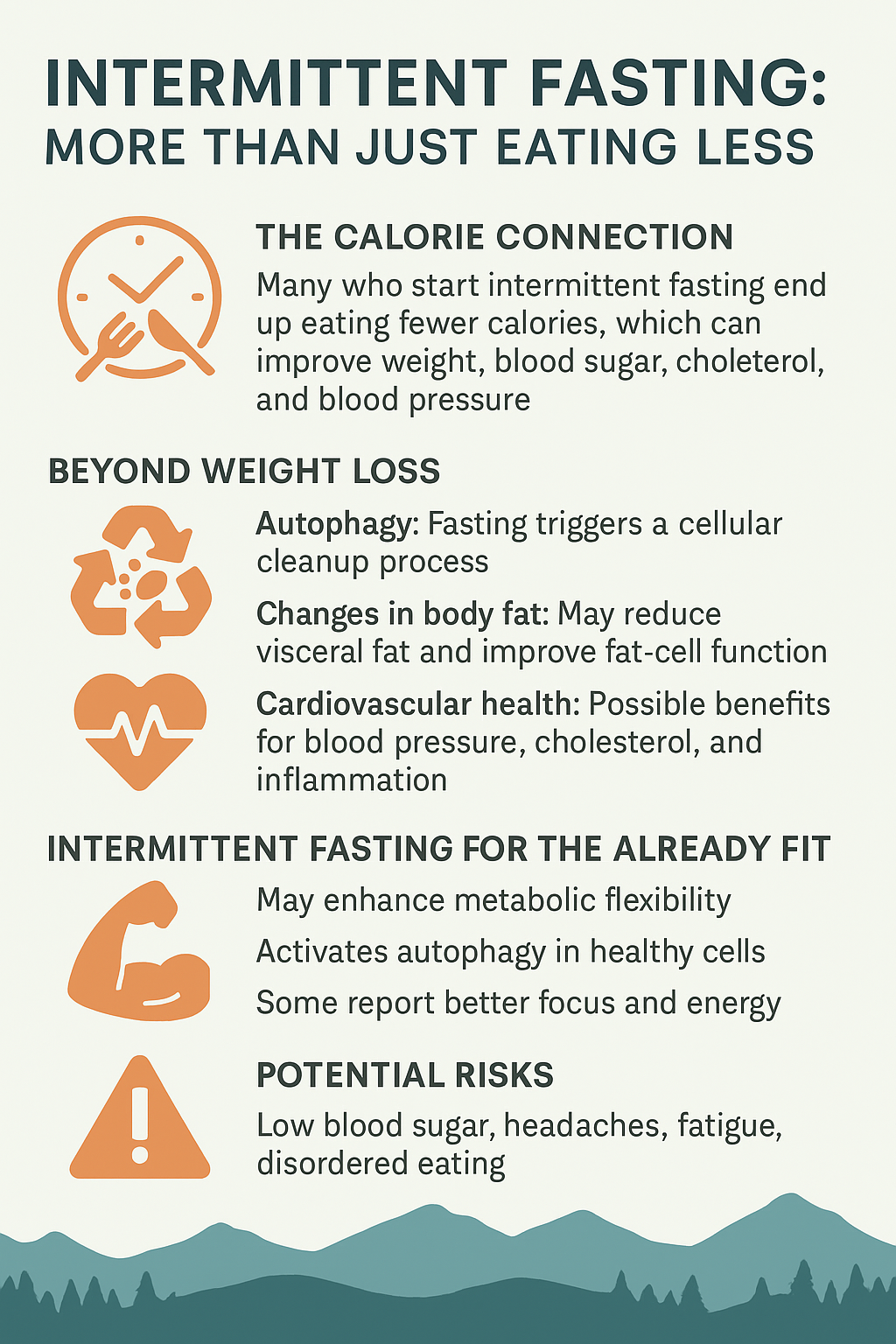
Here’s the first truth bomb: most of fasting’s benefits come from eating fewer calories and eating more consistently — not just from skipping meals.
When you shorten your eating window, you naturally:
Snack less
Eat smaller portions
Reduce late-night calories
That alone can improve blood sugar, blood pressure, cholesterol, and weight management.
So yes — fasting “works,” but mostly because it helps you stop grazing like a distracted raccoon after 9 p.m., not because it rewired your DNA overnight.
I’ve been there — once I ate chocolate like it was going out of style and felt awful afterward. Sometimes having a structure like intermittent fasting helps prevent those mindless snack attacks.
🔄 Beyond Calorie Reduction — What Else Happens?
But here’s where it gets interesting: even when total calories stay about the same, fasting can still shift how your metabolism behaves.
Think of it like this:
Calorie restriction changes how much fuel you put in the tank.
Fasting changes when and how efficiently your body burns it.*
Let’s look at what science says fasting does beyond the calorie math.
🧬 What Fasting Actually Does
🩸 1. Insulin Sensitivity
When you go longer between meals, insulin levels drop.
That break helps cells become more responsive again — meaning your body handles carbs more efficiently the next time you eat.
It’s like giving your metabolism a breath of fresh air instead of keeping it on call 24/7.
However, it’s not as simple as hitting a “reset” button for your cells. Other factors matter too — physical activity, balanced nutrition, and overall calorie balance all influence insulin sensitivity.
So yes, we’ll give intermittent fasting a point for this — but you don’t have to fast to earn that benefit. Eating balanced meals, moving regularly, and maintaining a consistent rhythm can achieve the same results.
In short: Longer intervals between meals may help lower insulin and improve sensitivity, especially when combined with early meal timing and calorie control — but the idea of a total “reset” is an oversimplification.
🌙 2. Your Body Clock Realigns
You have a built-in metabolic rhythm — your hormones, enzymes, and insulin sensitivity all fluctuate through the day.
You digest better earlier and slower at night.
Studies on early time-restricted eating (7 a.m.–3 p.m.) show improved blood sugar and blood pressure even when calories stay constant.
Translation: it’s not just what you eat, but when.
Your pancreas appreciates a bedtime too.
Research shows insulin sensitivity and glucose tolerance are highest in the morning and decline throughout the day, hitting their lowest levels at night. That means your body handles carbs best earlier — and late-night eating keeps glucose elevated longer.
🧹 3. Autophagy: The Cleanup Crew (and the Caveat)
Here’s the buzzy word that has been thrown around… maybe not in everyday conversation but from some influencer trying to make a buck: autophagy (aa·taa·fuh·jee) - had to add that because how the F do you even say that word.
So what is it? Simply put, ti’s your body’s recycling program — breaking down and reusing damaged cell parts to keep things running smoothly.
It’s real science (it even earned a Nobel Prize in 2016), but here’s what gets lost online:
Most data come from animal and lab studies, not long-term human trials.
Measuring autophagy in people is complicated and indirect.
No research shows fasting “reverses disease” through autophagy alone
Bottom line: Autophagy is part of fasting’s biology — not a guaranteed outcome or a detox button.
And honestly, I want it to be true. If fasting gives your body a cleanup advantage and you feel better doing it — great. I’m all for it. But we need more human research before declaring victory.
💪 4. Other Emerging Benefits
Fasting may also improve metabolic flexibility — your body’s ability to switch between burning carbs and fats for energy.
That can enhance energy stability and long-term metabolic health.
We’ll unpack this more in a future post (it’s a fascinating topic), but for now, consider it a potential bonus benefit rather than a sure thing.
🥗 Diet Quality Still Runs the Show
Let’s be clear: if your “eating window” is full of chips, energy drinks, and leftover Halloween candy, fasting won’t save you.
Quality matters more than the clock. Say it louder for the ones in the back!!
Fasting gives you structure. Nutrition gives you results. The real magic happens when both align.
Your foundation never changes:
Protein does way more than keep you full — it builds and repairs tissue, supports immune and enzyme function, balances hormones, and maintains lean mass. (Basically, protein’s the overachiever in the nutrition world.)
Healthy fats (olive oil, nuts, seeds, avocado) support hormone production, brain health, and heart function — and help your body absorb the fat-soluble vitamins A, D, E, and K. So drizzle that olive oil with purpose.
High-fiber carbs (beans, fruits, veggies, and whole grains) keep blood sugar steady, feed your gut microbiome, and improve gut motility — nature’s way of saying, “Let’s keep things moving.” 🚶♂️
Colorful produce floods your system with antioxidants and phytonutrients that lower inflammation and oxidative stress — your body’s built-in cleanup crew.
Fasting might help you time your meals — but what you eat determines how your body performs once you do.
🍽️ The Case for Three Balanced Meals
Here’s the twist: You don’t have to fast to get steady glucose and metabolic benefits.
Several studies show that three structured meals per day — especially with a hearty breakfast and lighter dinner — can:
Improve blood-sugar control
Reduce insulin spikes
Keep energy stable throughout the day
In one Diabetes Care study, people eating three meals (instead of six small ones) had better glucose, lower insulin, and less hunger — even without fasting.
Consistency counts just as much as compression.
🩸 Glucose Control: Fasting vs Three Meals
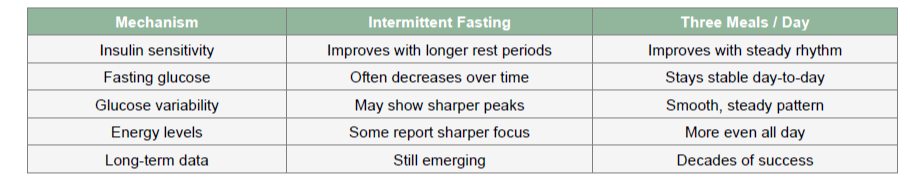
Both can support blood-sugar control — fasting gives your metabolism longer breaks, while structured meals provide smoother daily glucose curves.
Different tools, same toolbox.
⏰ Circadian Rhythms and Timing
Whether you fast or not, when you eat matters.
You’ll always see better results eating earlier in the day — breakfast and lunch are your metabolic A-team.
Late-night meals confuse your body clock and raise fasting glucose by morning.
So instead of stressing over 16-hour windows, start with this:
🍽️ Eat your biggest meal earlier.
🌙 Wrap up dinner before 7 p.m.
🛌 Let your hormones and pancreas rest when you do.
Simple. Effective. Free.
🧗♀️ Who Benefits from Each
Three Meals a Day
✅ Best for:
People with diabetes, hypoglycemia, or high activity needs
Families or those who thrive on structure
Anyone who loves breakfast and predictable energy
Fasting / Time-Restricted Eating
✅ Best for:
Adults with insulin resistance or overweight
People who prefer simplicity (less meal prep, fewer snacks)
Those trying to realign circadian rhythm or improve focus
Neither is superior — it’s about what you can actually sustain.
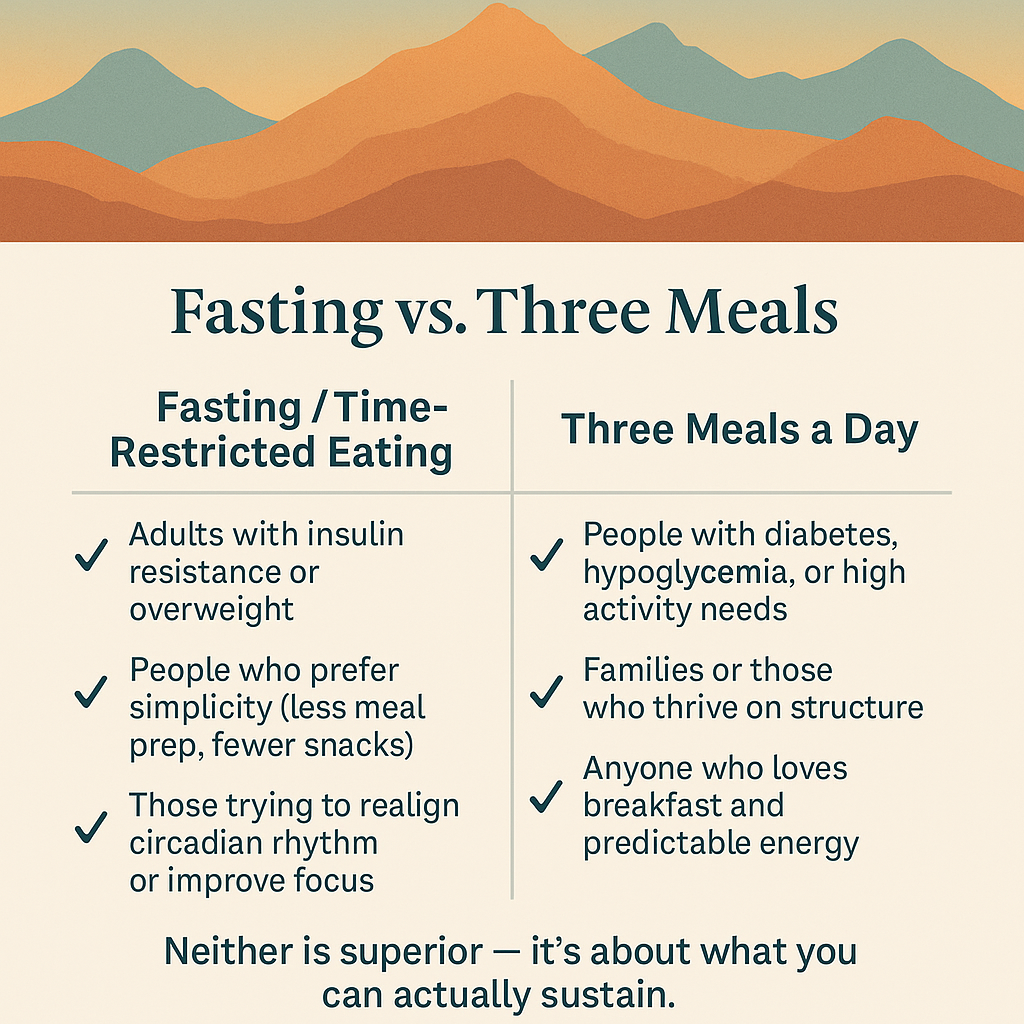
IF vs 3 - meals per day comparison
⚠️ When Fasting Might Backfire
If you’ve tried fasting and felt hangry, dizzy, or ready to punch a granola bar — you’re not broken.
Fasting just may not suit your biology.
Avoid or modify it if you:
Have type 1 diabetes or take insulin
Are pregnant, breastfeeding, or underweight
Have a history of eating disorders
Struggle with poor sleep, high stress, or thyroid issues
Health isn’t about extremes — it’s about consistency that fits your real life.
🌿 The Whole-Health Takeaway
Intermittent fasting isn’t a miracle. Three meals a day isn’t outdated.
They’re both frameworks — and both can improve health when done with balance, quality, and rhythm.
Fasting may lower insulin and support cellular repair. Structured meals keep glucose steady and energy smooth.
Neither one works without real food, movement, and sleep.
Health isn’t built in an eight-hour window — it’s built through rhythm, nourishment, and consistency.
And remember: your pancreas doesn’t care what’s trending — it just wants balance.
🧠 RD Reality Check: Summary of the Science
✅ What’s Backed by Evidence
Weight Loss & Calorie Control: Fasting can reduce total calorie intake and modestly lower body weight — but mainly because people eat less overall, not because fasting “supercharges metabolism.”
Harris et al., 2018; Cioffi et al., 2018
Insulin Sensitivity: Early time-restricted fasting (e.g., 8 a.m.–4 p.m.) can improve insulin and glucose control — especially in people with prediabetes or overweight.
Jamshed et al., 2019; Sutton et al., 2018
Circadian Rhythm Benefits: Eating earlier in the day improves blood sugar and metabolic function even without cutting calories.
Manoogian & Panda, 2017; Hutchison et al., 2019
⚖️ What’s Still Mixed
Cholesterol & Blood Pressure: Some studies show improvements, others show no change. The effects often mirror what you’d get from general calorie reduction.
Tinsley & La Bounty, 2015
Metabolic Flexibility: Early evidence suggests fasting may help your body switch between carbs and fats more efficiently — but this hasn’t been confirmed in long-term human trials.
Moro et al., 2016
🚫 What’s Not Proven
Autophagy: Most claims about “cell cleanup” are based on animal studies. We don’t yet have real-time human data confirming fasting activates it.
Levine & Kroemer, 2019
Longevity or Hormone “Resets”: Promising in rodents, unproven in people.
Longo & Panda, 2016
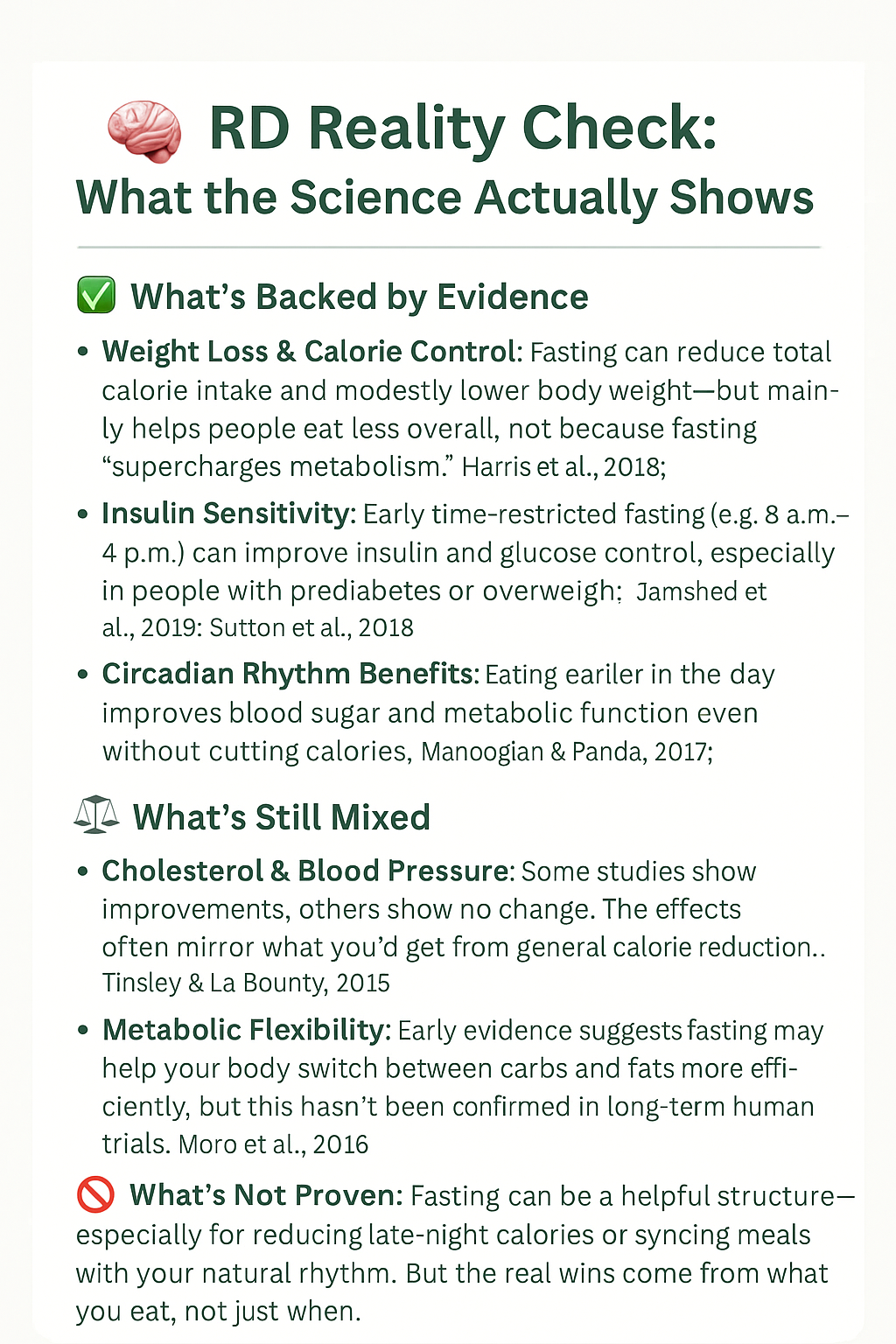
RD Reality Check Pic
🕐 Fasting Guidelines: Finding the Right Fit
If you’re curious about intermittent fasting and want to give it a try, here are some general guidelines to keep it safe, sane, and snack-guilt-free.
Because let’s be honest — fasting isn’t one-size-fits-all. The best plan is the one that supports your energy, mood, and blood sugar — not the one that leaves you side-eyeing your coworker’s granola bar at 10 a.m.
Fasting can work for some people… but so can breakfast burritos.
It all comes down to what fits your life, not your Instagram feed.
So IF (see what I did there?) you want to try it out, here’s how the most common fasting structures stack up 👇
⏰ The 16:8 Method (Most Common & Research-Backed)
How it works:
Fast for 16 hours, eat during an 8-hour window (e.g., 10 a.m.–6 p.m. or 9 a.m.–5 p.m.).
Recommended for:
People aiming for modest weight loss or metabolic reset
Adults with insulin resistance or elevated fasting glucose
Those who prefer a structured but flexible pattern
Benefits:
✅ Improves insulin sensitivity and fasting glucose
✅ Reduces late-night snacking and total calorie intake
✅ May support mild autophagy and gut rest
✅ Easy to sustain long-term with social flexibility
Cautions:
⚠️ Skipping breakfast may reduce morning performance or focus for some
⚠️ Not ideal for athletes training early, or people prone to low blood sugar
Pro tip: Shift the window earlier (e.g., 8 a.m.–4 p.m.) if you want greater metabolic benefits — research shows earlier eating aligns better with your body’s circadian rhythm.
🌞 The 14:10 Method (Gentler, Beginner-Friendly)
How it works:
Fast for 14 hours, eat during a 10-hour window (e.g., 8 a.m.–6 p.m.).
Recommended for:
Beginners
People who value consistency and energy over strict rules
Those with higher physical activity or family meals in the evening
Benefits:
✅ Easier to start and maintain
✅ Still supports better insulin sensitivity and calorie control
✅ Fits typical family meal patterns
Cautions:
⚠️ Less pronounced metabolic effects than 16:8
⚠️ Requires consistency — late-night snacking cancels benefits
🌙 The 18:6 or 20:4 (Advanced Fasting Windows)
How it works:
Fast for 18–20 hours; eat all meals in a 4–6 hour window.
Recommended for:
Experienced fasters
People with good metabolic health looking for deeper cellular repair (autophagy)
Those seeking appetite reset or metabolic flexibility
Benefits:
✅ Stronger potential for autophagy activation
✅ May aid fat loss and glucose stability for some individuals
Cautions:
⚠️ Harder to sustain; may cause fatigue or nutrient gaps
⚠️ Can backfire if you overeat during the eating window
⚠️ Not suitable for people with blood sugar instability, thyroid issues, or athletes
🧬 Other Fasting Approaches
5:2 Method
Eat normally five days a week, restrict calories (~500–600) on two non-consecutive days.
Benefits: Can improve insulin sensitivity and reduce inflammation.
Downside: Harder to maintain, higher hunger risk on fasting days.
Alternate-Day Fasting
Fast (or very low-calorie days) every other day.
Benefits: Effective for weight loss and metabolic health in clinical trials.
Downside: High dropout rate — not sustainable for most.
🥗 General Fasting Guidelines
During the fasting window:
Hydrate — water, black coffee, herbal or green tea are all fine
Avoid sweetened beverages, creamers, or anything with calories
A pinch of salt or electrolyte water can help if you feel lightheaded
During the eating window:
Focus on protein, fiber, and healthy fats for satiety
Include fruits, vegetables, and whole grains for micronutrients
Break your fast with something balanced (e.g., eggs + veggies + avocado toast or a lentil bowl)
Avoid binge eating — aim for consistency, not “make-up” calories
🧠 My RD Take
Fasting and structured eating are both tools — not religions. They work when they fit your biology, schedule, and sanity. I am currently going to give it a shot to see how I feel on it and I can certainly let you know how it goes!
What matters most:
Consistency beats extremes
Timing matters, but quality rules
Your plan should work for you — not the other way around
📚 Resources & Research
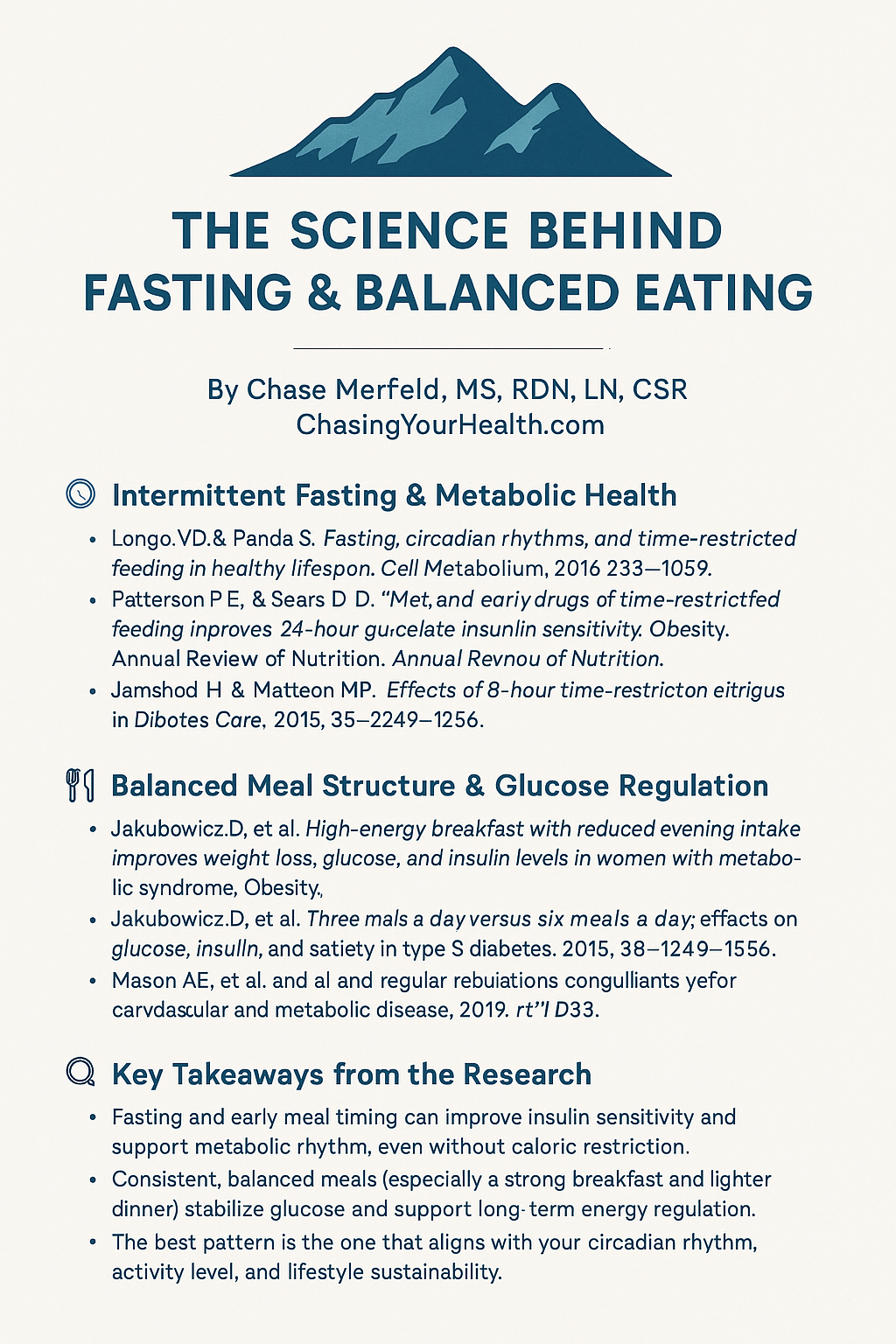
🕐 Intermittent Fasting & Metabolic Health
Longo VD & Panda S. Fasting, circadian rhythms, and time-restricted feeding in healthy lifespan. Cell Metabolism. 2016;23(6):1048–1059.
→ Landmark review highlighting how fasting and meal timing interact with biological clocks to influence longevity and metabolism.Patterson RE & Sears DD. Metabolic effects of intermittent fasting. Annual Review of Nutrition. 2017;37:371–393.
→ Comprehensive overview of human and animal studies examining insulin sensitivity, inflammation, and weight outcomes.Jamshed H, et al. Early time-restricted feeding improves 24-hour glucose levels and insulin sensitivity in prediabetic men. Cell Metabolism. 2019;29(3):723–732.
→ Demonstrated improved metabolic markers even without calorie restriction when meals were eaten earlier in the day.de Cabo R & Mattson MP. Effects of intermittent fasting on health, aging, and disease. New England Journal of Medicine. 2019;381:2541–2551.
→ High-impact review summarizing fasting’s potential benefits for cardiovascular, neurological, and metabolic health.Cienfuegos S, et al. Effect of 8-hour time-restricted feeding on body weight and metabolic disease risk factors in obese adults. Nutrition & Healthy Aging. 2020;6(4):283–295.
→ Found that an 8-hour eating window reduced body weight and improved insulin resistance in adults with obesity.
🍽️ Balanced Meal Structure & Glucose Regulation
Jakubowicz D, et al. High-energy breakfast with reduced evening intake improves weight loss, glucose, and insulin levels in women with metabolic syndrome. Obesity. 2013;21(12):2504–2512.
→ Showed that eating a larger breakfast and smaller dinner improved glycemic control and hunger regulation.Jakubowicz D, et al. Three meals a day versus six meals a day: effects on glucose, insulin, and satiety in type 2 diabetes. Diabetes Care. 2015;38(7):1249–1256.
→ Participants eating three structured meals had better glucose control and lower insulin levels than those grazing on six smaller meals.Garaulet M & Gómez-Abellán P. Timing of food intake and obesity: a novel association. Physiology & Behavior. 2014;134:44–50.
→ Explores how meal timing and circadian alignment influence weight regulation and metabolic outcomes.Mason AE, et al. Meal timing and circadian rhythm: implications for cardiovascular and metabolic disease. Current Diabetes Reports. 2020;20(7):38.
→ Discusses the synergy between meal timing, circadian biology, and chronic disease prevention.