
⚙️ Metabolic Flexibility: A Tool for Energy, Blood Sugar, and Longevity (Long version)
By Chase Merfeld, MS, RDN, LN, CSR
ChasingYourHealth.com
🌄 What If Your Metabolism Worked Like a Hybrid Car?
Imagine your metabolism as a hybrid vehicle:
🚗 When gas is available, it uses gas.
🔋 When it needs to, it switches to electric mode.
No sputtering. No stalling. Just smooth energy management.
A flexible metabolism works the same way — switching between carbohydrates (glucose) and stored body fat depending on what the body needs.
This adaptable fuel system is called metabolic flexibility, and it’s emerging as a key factor in:
✔ stable energy
✔ fewer cravings
✔ better blood sugar control
✔ improved weight loss potential
✔ reduced diabetes risk
✔ healthier aging and metabolic resilience
🌟 What Is Metabolic Flexibility?
Metabolic flexibility is your body’s ability to switch between fuel sources smoothly:
After you eat → you primarily burn carbohydrates (glucose).
Between meals or overnight → you shift to fat-burning.
During exercise → you use a mix, depending on intensity.
In emergencies → you may burn protein, which we want to avoid.
A flexible metabolism can use glucose when it’s there … and fat when it’s not.
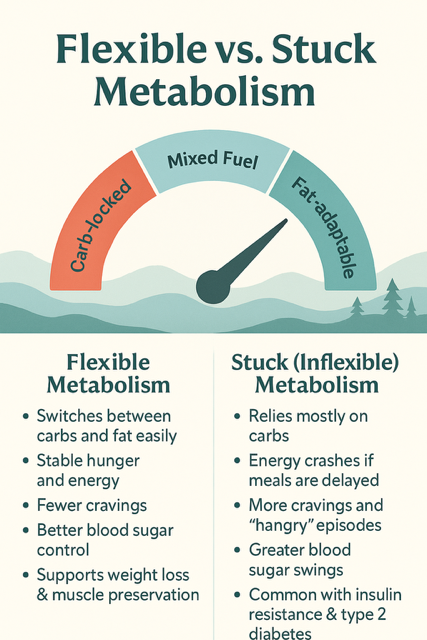
A metabolically inflexible body gets “stuck” in carb dependence, often resulting in hunger swings, energy crashes, and difficulty losing fat.
🧠 Quick Comparison
”why it matters”
📏 How Metabolic Flexibility Is Measured
There are two proven research measurements:
1️⃣ Respiratory Exchange Ratio / Respiratory Quotient (RER/RQ)
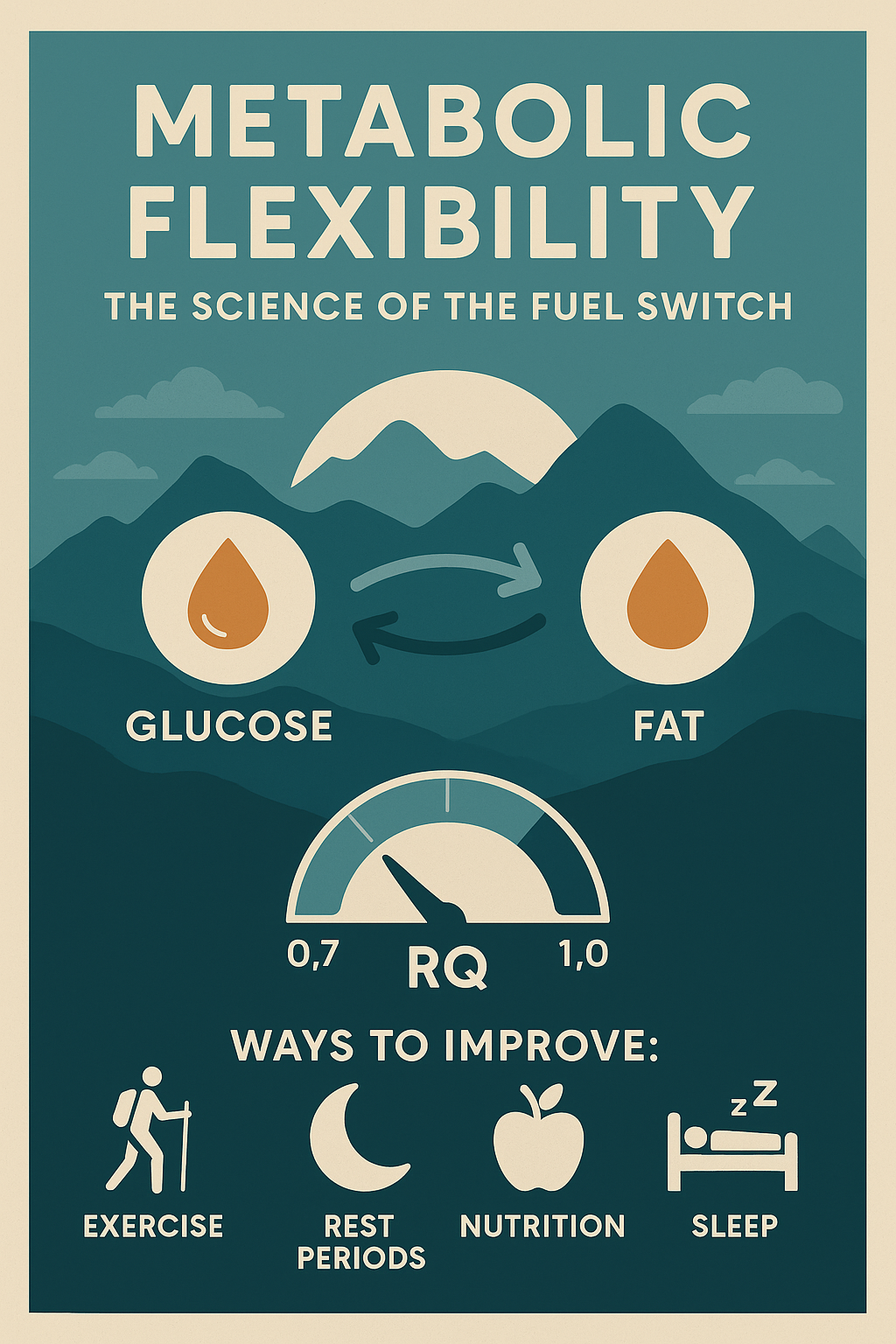
The respiratory exchange ratio (RER) is the ratio of carbon dioxide produced (VCO₂) to oxygen consumed (VO₂) during metabolism, measured via indirect calorimetry. RER values typically range from about 0.7 (predominant fat oxidation) to 1.0 (predominant carbohydrate oxidation), with intermediate values reflecting mixed substrate use.
RER is used to assess metabolic flexibility by quantifying how effectively an individual can switch between fat and carbohydrate oxidation in response to physiological challenges such as fasting, feeding, or exercise. For example, a healthy, metabolically flexible person will show a low RER during fasting (reflecting fat oxidation) and a higher RER after carbohydrate ingestion or during insulin stimulation (reflecting increased carbohydrate oxidation)
Respiratory Quotient (RQ/RER) and what it tells us
RQ ≈ 0.7
Indicates: mostly fat is being burned
RQ ≈ 0.85
Indicates: mixed fuel use (both carbs and fats)
RQ ≈ 1.0
Indicates: mostly carbohydrates are being burned
A blunted or delayed RER response—such as a failure to decrease RER during fasting or to increase RER after carbohydrate intake—indicates impaired metabolic flexibility, which is commonly seen in obesity, insulin resistance, and type 2 diabetes.
Metabolic flexibility means: your RQ can move across this range appropriately depending on whether you’re fed, fasted, or exercising
2️⃣ Hyper insulinemic–Euglycemic Clamp
This is considered the gold standard for quantifying metabolic flexibility.
⭐ What It Is
A controlled research test where insulin is infused into the bloodstream and glucose is added at a carefully controlled rate to keep blood sugar normal (“euglycemia”).
The goal:
👉 See how much glucose your body needs to stay in a normal range when insulin is high.
This tells researchers how sensitive your body is to insulin.
⭐ How It Works (Simple Version)
1️⃣ Insulin infusion
A steady dose of insulin is given IV to raise insulin levels in the blood.
2️⃣ Glucose infusion
At the same time, glucose is infused to keep blood sugar from dropping too low.
3️⃣ Frequent measurements
Blood glucose is checked every few minutes.
4️⃣ Adjustment
The glucose infusion is increased or decreased to keep sugar stable at ~90 mg/dL.
⭐ What the Results Mean
If you need a lot of glucose
→ Your tissues (muscles) are very insulin sensitive
→ They are pulling lots of glucose out of the blood
→ Metabolic flexibility is good
If you need very little glucose
→ Your tissues resist insulin
→ You have insulin resistance
→ Metabolic flexibility is reduced
⭐ Why Researchers Use It
Because it’s the most accurate way to measure:
insulin sensitivity
glucose uptake by muscle
metabolic flexibility
risk of diabetes
effects of diet/exercise interventions
It’s used in high-level metabolic research and rarely in clinical practice because it’s resource-intensive.
🧩 How Do Macros Fit Into This? (Carbs, Fat & Protein Explained)
People talk about tracking macros, going low carb, doing high protein, or trying keto—but here’s what macros really are:
🍞 Carbohydrates: Fast, efficient fuel. Stored as glycogen in your liver and muscle— your reserve tank.
🥑 Fat: Slow, steady energy. Long-term storage.
🍗 Protein: Not meant to be a main fuel source — essential for structure and repair.
🍽️ Why a Balanced Diet Improves Metabolic Flexibility
Metabolic flexibility isn’t built from extremes.
It’s built from balance.
A balanced diet supports the metabolic “fuel switch” because it gives your body all three macronutrients it needs to move smoothly between energy sources — instead of forcing it into stress mode.
Here’s exactly why balance matters:
🔹 1. Balanced eating stabilizes blood sugar and insulin
When meals contain protein + fiber + healthy fat + smart carbs, digestion slows down and glucose enters the bloodstream more gradually.
This gives you:
✔ steadier energy
✔ smaller insulin spikes
✔ fewer crashes
✔ a smoother transition between glucose → glycogen → fat
Stable insulin is one of the strongest drivers of metabolic flexibility.
Wild swings = metabolic chaos.
Steady curves = metabolic adaptability.
🔹 2. Balanced meals keep your glycogen “bridge fuel” working properly
Glycogen is the middle step between carb-burning and fat-burning.
A balanced diet:
replenishes liver glycogen
supports muscle glycogen for movement
prevents overly fast depletion
allows smoother shifts into fat oxidation
When glycogen is chronically low or chronically overloaded, fuel switching becomes harder.
Balanced eating maintains the “just right” zone.
🔹 3. Protein protects muscle — the engine of metabolic flexibility
A balanced diet ensures adequate protein, which:
maintains muscle mass
improves mitochondrial function
increases insulin sensitivity
reduces hunger and cravings
prevents muscle breakdown during fasting or longer meal gaps
Muscle is where most fuel switching happens.
Less muscle = reduced metabolic flexibility.
Balanced meals protect your metabolic machinery.
🔹 4. Healthy fats support stable energy and fat oxidation
Including healthy fats (olive oil, nuts, avocado, seeds, fatty fish):
slows digestion
stabilizes glucose
improves satiety
encourages fat-burning between meals
provides building blocks for hormones
A body that routinely uses fat for energy is a more flexible metabolism.
🔹 5. Fiber feeds the gut microbiome — which regulates metabolism
More fiber = a healthier microbiome.
And the microbiome influences:
insulin sensitivity
inflammation
cravings
fat oxidation
glucose response
mitochondrial function
Fiber is one of the quiet heroes of metabolic flexibility.
🔹 6. Balanced meals prevent metabolic “panic mode”
When meals are:
❌ too low in carbs
❌ too low in fat
❌ too low in protein
❌ too low in calories
❌ erratic or unbalanced
…the body feels insecure about fuel availability.
That insecurity triggers:
higher cortisol
more cravings
muscle breakdown
poor fat oxidation
more reliance on glucose
less ability to fast comfortably
Balanced eating reassures your metabolism:
“You’re safe. We’ve got what we need.”
A calm metabolism is a flexible metabolism.
🔹 7. Balanced eating promotes consistency — the secret ingredient
Extreme diets create extreme responses.
Balanced habits create predictable, healthier metabolic signals.
Consistency is what allows the body to practice fuel switching every day.
The more often your body experiences:
stable glucose
natural meal gaps
nutrient variety
predictable energy supply
…the more flexible your metabolic system becomes.
⏳ Intermittent Fasting & Metabolic Flexibility
Since we talked about intermittent fasting a couple weeks ago let’s tie that in here.
⏳ Fasting creates the opportunity for fuel switching. Your body doesn’t have a direct source during this time, which makes your body decide what macro source to utilize as energy.
🥦 Macros determine how well you can switch fuels. Balanced meals (protein + fiber + healthy fats) support easier transitions and fewer crashes, while constant grazing or extreme restriction can interfere with fuel flexibility.
🔄 The Fuel Switching Timeline (How fuel use changes over time)
0–4 hours after eating
Main fuel: glucose from food
What’s happening:
Insulin is higher
Body burns carbs first
Extra carbs are stored as glycogen (storage form of glucose) or fat
4–16 hours after eating (varies by person)
Main fuel: glycogen, then fat
What’s happening:
Insulin is falling
Liver releases glycogen to keep blood sugar stable
Body begins increasing fat oxidation
Prolonged low-fuel states or uncontrolled diabetes
Main fuel: protein (muscle) + fat
What’s happening:
Body breaks down muscle into amino acids
Liver converts amino acids to glucose (gluconeogenesis)
This is survival mode, not the goal
If you trial Intermittent Fasting make sure you get enough protein during feasting times or this would happen to you. Fasting it not for everyone and needs to be done properly.
How They Work Together — and Why Some People Feel Miserable
Intermittent fasting doesn’t magically create flexibility. It reveals it. It simply puts the body in a situation where fuel switching is required.
If the metabolic machinery is already functioning well → the transition is smooth.
If the machinery is impaired (low mitochondrial density, poor fat oxidation, high insulin, dysregulated glycogen cycling) → the transition is rough.
To put it simply: fasting reveals the current state of fuel-switching capacity.
If fasting feels horrible → the body is struggling to switch to fat.
If fasting feels smooth → flexibility is strong.
Fasting helps flexibility by:
✔ lowering insulin between meals
✔ allowing glycogen to cycle normally
✔ encouraging fat-use
✔ pairing well with movement & strength training
Fasting does not:
❌ fix insulin resistance alone
❌ bypass calorie balance (Fats, Carbs, Proteins at meals)
❌ require extreme protocols
❌ work if the person is metabolically inflexible
Fasting trains the timing. Flexibility determines the experience.
Gentle windows (12:12, 13:11, 14:10) are often best. However, fasting is not for everyone. I have been trialing it for 2 days and not loving it.
🟡 Glycogen: The Bridge Between Carbs & Fat
Glycogen is stored glucose in your liver and muscles. It is a crucial transition fuel, allowing a smooth shift from carb-burning to fat-burning.
Healthy glycogen cycling supports:
✔ stable energy between meals
✔ less urgency to snack
✔ overnight blood sugar stability
✔ strength and endurance during exercise
✔ reduced risk of muscle breakdown
In insulin resistance & type 2 diabetes, glycogen storage and release can become dysregulated, contributing to higher fasting glucose and impaired fat access. Which is why metabolic flexibility is so important.
💉 Metabolic Inflexibility & Diabetes
Research shows that metabolic inflexibility is a core feature of insulin resistance and type 2 diabetes. In these conditions:
Muscle responds less effectively to insulin
Glucose struggles to enter cells
Liver may release excess glucose
Fat-burning is suppressed by higher insulin
Fuel switching becomes sluggish or stuck
This creates metabolic inflexibility — the reduced ability to switch between fuels.
Studies show people with diabetes often have:
lower fat oxidation (breakdown of fat for energy)
higher reliance on glucose as main energy source (body gets used to using sugar and doesn’t want to change)
reduced mitochondrial efficiency
BACK TO BIOLOGY: Mitochondria is our cells powerhouse - makes energy
Mitochondrial efficiency refers to the ability of mitochondria to generate ATP from available substrates (the fat, carbs, and protein) with minimal energy loss, and it is closely linked to metabolic flexibility
increased intramuscular fat
more difficult transitions into fasting
This is physiology, not failure.
The encouraging part: Metabolic flexibility improves with the right habits.
🔥 How Metabolic Flexibility Supports Weight Loss
Metabolic flexibility does not replace calorie balance, but it supports weight loss because it:
✔ Improves access to stored fat
More time in fat-burning mode between meals and overnight.
✔ Reduces cravings and energy crashes
Stable glucose = fewer emergency snacks.
✔ Preserves muscle mass
Fat is burned instead of protein, keeping metabolism higher.
✔ Supports exercise performance & recovery
Better fuel switching means better training adaptation.
People often describe weight loss as feeling easier, calmer, and more sustainable with improved metabolic flexibility.
🧯 When Fuel Runs Low: Why We Don’t Want to Burn Muscle
If the body cannot access glucose or fat, especially in extreme fasting, severe caloric restriction, illness, or uncontrolled diabetes, it may convert muscle protein into glucose (gluconeogenesis).
This can lead to:
decreased muscle & strength
slower metabolism
reduced exercise capacity
increased nitrogen/urea burden & hydration needs
harder long-term weight maintenance
We want fat to be the “backup generator,” not muscle.
So even if you are fasting it’s very important to get adequate protein during eating times.
Aim for:
1.2–1.6 g/kg/day for most adults
>1.6 g/kg/day if you strength train or are dieting aggressively
Adequate protein means your body has no reason to borrow amino acids from muscle during fasting.
Another way to prevent muscle loss is to strength train! No matter how old you are I promote strength training. You don’t have to shoot for body builder, but aim to maintain or build some muscle.
Strength training is a metabolic multivitamin:
✔ preserves muscle
✔ increases glycogen storage
✔ boosts mitochondrial capacity
✔ improves insulin sensitivity
✔ enhances fat oxidation
This makes your metabolism MUCH less likely to use muscle for energy.
🧘♀️ How to Improve Metabolic Flexibility
Ways to support metabolic flexibility & why they help
Walk after meals
Helps your muscles take up glucose
Reduces post-meal blood sugar spikes
Encourages better use of fuel you just ate
Leave 3–4 hours between meals when possible
Allows insulin to come back down
Gives your body a chance to switch into fat-burning mode
Reduces constant “carb-only” dependence
Use gentle fasting windows (12:12 or 14:10)
Trains your body to be okay without constant incoming fuel
Promotes using glycogen, then fat stores, without extreme deprivation
Prioritize protein, fiber, and healthy fats at meals
Smooths out blood sugar responses
Increases satiety
Makes fasting periods or meal gaps feel easier
Lift weights / build muscle
Increases mitochondrial density & glycogen storage capacity
Makes your body better at using carbs and fats
Protects metabolism during weight loss
Protect sleep & manage stress
Keeps cortisol, insulin, and other hormones in a healthier rhythm
Improves how the body uses fuel across the whole day
🌱 Whole Health for Flexibility
Metabolic flexibility doesn’t happen from one habit.
It’s the result of a whole-health lifestyle — the small decisions you make day after day that support your metabolism, hormones, and nervous system.
Here are the core components that build metabolic flexibility in a sustainable, realistic, “Chasing Your Health” way:
🍽️ 1. Balanced, Consistent Nutrition
Not perfect eating — balanced eating.
Protein at each meal (muscle protection)
Fiber-rich foods (blood sugar stability + gut health)
Healthy fats (hormones + sustained energy)
Smart starches (glycogen support)
Colorful produce (antioxidants + inflammation control)
Eating rhythm with natural breaks between meals
This nourishes the body, stabilizes insulin, and prevents constant grazing that disrupts flexibility.
🚶♂️ 2. Movement Throughout the Day
Not just workouts.
Micro-movements.
A 10-minute walk after meals
Standing breaks
Light stretching during work
Walking meetings
Gentle morning movement
Playing outside with your kids
Movement is one of the strongest signals to your metabolism that says:
“Use fuel efficiently.”
🏋️ 3. Regular Strength Training
Muscle isn’t just aesthetic — it’s metabolic gold.
Stores glycogen
Improves insulin sensitivity
Increases mitochondrial density
Boosts fat oxidation
Supports longevity
More muscle = easier fuel switching = better flexibility.
😴 4. Quality Sleep
When sleep goes down, insulin resistance goes up.
One poor night can disrupt:
hunger hormones (ghrelin ↑, leptin ↓)
cravings
blood sugar
cortisol
decision making
Even aiming for consistency (same sleep/wake times) improves flexibility.
😌 5. Stress Regulation & Nervous System Support
Chronic stress = elevated cortisol = impaired fat-burning.
Support your system with:
deep breathing
stretching
time outdoors
prayer/meditation
hobbies
saying “no”
protecting downtime
lowering the all-day mental load
A calm body burns fuel more efficiently than a chaotic one.
💧 6. Hydration & Electrolytes
Dehydration reduces metabolic efficiency and increases perceived fatigue.
Hydration supports:
nutrient delivery
muscle function
consistent energy
glycogen storage and release
kidney function during fat metabolism
Think: water + minerals, especially if you fast or exercise.
🧠 7. Mindset & Self-Talk
Your mindset affects your hormones and habits.
People who focus on progress over perfection experience:
lower stress
better compliance
healthier eating patterns
more positive relationship with food
increased self-efficacy (belief that change is possible)
A shame-based approach shuts metabolism down.
A compassionate approach supports adaptation.
👨👩👦 8. Community & Support Systems
Humans regulate better together.
Connection improves:
motivation
cortisol patterns
health behaviors
long-term habit success
resilience during change
This can be family, coworkers, church groups, fitness friends, or your online community.
🏡 9. Environment That Supports Your Goals
Small changes matter:
Healthy foods accessible
Comfort foods not front-and-center
A water bottle in sight
Walking shoes by the door
Screens off earlier
Sleep-friendly room setup
Movement reminders
Your environment can either drain your willpower or reduce your need to use it.
🎯 10. Purpose & Personal Meaning
Why are you doing this?
For your kids.
For your health.
For longevity.
For better energy.
For confidence.
For the life you want to enjoy.
Purpose strengthens discipline — and metabolic habits stick when they matter to you.
🌀 Whole-Health Summary: “The body adapts when the whole person is supported.”
Metabolic flexibility isn’t only about fasting or macros.
It is shaped by: Nutrition + Movement + Sleep + Stress + Hydration + Muscle + Environment + Community + Mindset + Purpose
When these pieces work together, your metabolism becomes more:
✔ resilient
✔ adaptable
✔ stable
✔ efficient
✔ flexible
And that’s the goal: A metabolism that can handle real life — not perfect conditions.
📌The Takeaway
Metabolic flexibility is the body’s ability to switch smoothly between burning carbohydrates and burning fat, supporting steady energy, better blood sugar control, easier fat loss, and stronger metabolic health — especially important in insulin resistance and diabetes.
🧠 My RD Take
Metabolic flexibility isn’t about perfection — it’s about giving your body the space and support it needs to do what it was designed to do: adapt.
Whole health is never built from one big change like intermittent fasting alone. It’s built from the small ones:
• a walk after dinner
• a balanced meal
• a night of decent sleep
• choosing calm over chaos
• moving your body in ways that feel good
These habits tell your metabolism: “You’re safe. You’re supported. You can switch fuels.”
Health isn’t rigid.
It’s adaptive.
It’s consistent.
It’s lived in the small moments.
That’s how we create a metabolism that works with us — not against us. Consistency in what you enjoy that impacts your whole health is key!
🧪 Research Highlights (Human Studies)
Caloric restriction improved metabolic flexibility and fat-oxidation gene expression in overweight adults (Scientific Reports, 2020).
Impaired fuel switching predicted poorer insulin-resistant outcomes during overfeeding challenges (Diabetes, 2020).
Exercise & nutrition interventions improved fuel switching and reduced metabolic risk (Endocrine Reviews, 2018).
Insulin-resistant adults showed reduced fat oxidation and substrate switching capacity (AJP Endocrinology & Metabolism, 2008).
Reducing sedentary time improved metabolic flexibility markers and insulin sensitivity (Scandinavian Journal of Medicine & Science in Sports, 2025).
Collectively, evidence supports metabolic flexibility as a modifiable mechanism that influences weight, insulin sensitivity, and metabolic disease outcomes.
🔍 References
Kelley DE, Mandarino LJ. (2000). Fuel metabolism in skeletal muscle. Diabetes.
Goodpaster BH, et al. (2001). Role of metabolic flexibility in insulin resistance. Metabolism.
Metabolic Flexibility in Health and Disease. (2015). PMC.
Metabolic Flexibility and Its Impact on Health Outcomes. (2022). PubMed.
Metabolic inflexibility during submaximal aerobic exercise… (2013). PMC.
Variance in respiratory quotient among daily activities and its… (2020). PubMed.
Gan Z, Klein CJMI, Keijer J, van Schothorst EM. (2025). Quantitative interpretation and modeling of continuous non-protein respiratory quotients. American Journal of Physiology: Endocrinology & Metabolism.
Fletcher GF, Ades PA, Kligfield P, et al. (2013). Exercise standards for testing and training. Circulation.
McDougal DH, Marlatt KL, Beyl RA, Redman LM, Ravussin E. (2020). Assessing metabolic flexibility overnight in a whole-body room calorimeter. Obesity.
Carnero EA, Bock CP, Distefano G, et al. (2021). 24-hour substrate oxidation and metabolic flexibility differences in type 2 diabetes. Diabetologia.
Alcantara JMA, Galgani JE. (2024). Metabolic flexibility indexes after an OGTT and links to cardiometabolic risk. European Journal of Clinical Nutrition.
Unlu Y, Piaggi P, Stinson EJ, et al. (2024). Impaired fasting metabolic flexibility and increased ad libitum energy intake in healthy adults. Obesity.
Galgani JE, Moro C, Ravussin E. (2008). Metabolic flexibility and insulin resistance. American Journal of Physiology: Endocrinology & Metabolism.
Yu EA, Le NA, Stein AD. (2021). Postprandial metabolic flexibility as an indicator of metabolic health. The Journal of Nutrition.
FAQ Section
Is metabolic flexibility the same as fat adaptation?
No. Fat adaptation is long-term reliance on fat as fuel. Metabolic flexibility is the ability to switch between fuels.
Does intermittent fasting improve metabolic flexibility?
It can, but only if your body already handles switching well. Fasting doesn’t create flexibility—it reveals it.
What improves metabolic flexibility the most?
Consistent eating patterns, balanced nutrition, strength training, sleep quality, and stress regulation.
Is metabolic flexibility important for longevity?
Yes. Better flexibility is linked to improved insulin sensitivity, stable energy, and healthier aging.