

🌱 Soy Real Talk: Busting Myths About Cancer, Hormones, and Health
Last week in The Fire Within, we talked about antioxidants — your body’s built-in firefighters.
This week, as we wrap up Breast Cancer Awareness Month, we’re tackling another nutrition topic that always stirs up confusion: soy.
For decades, soy has been one of the most misunderstood foods in nutrition.
One moment it’s a plant-based protein hero, the next it’s accused of causing cancer or “messing with hormones.”
So before the pink ribbons come down and the headlines fade, let’s take a clear, evidence-based look at soy — because understanding how food really works is one of the best ways to support prevention, survivorship, and whole-body health all year long.
We also want to fight back against miss information!
💡 Where the Fear Started
Back in the 1990s, early animal studies found that soy isoflavones — plant compounds with a structure similar to estrogen — appeared to stimulate tumor growth in mice bred for cancer research.
Cue the panic: “Soy acts like estrogen!” or men who say “I won’t eat that, my pecks will be breasts” - I hear this way more than I should… and that’s why science backing research is important here.
But here’s what those headlines missed:
Mice metabolize soy very differently than humans.
Rodents produce equol, a potent estrogen-like compound, at much higher levels — humans? Only about 30–50 % of us can even make it. Keep reading to understand what equol is.
Human hormonal systems are far more complex and tightly regulated. It’s almost like we humans are biologically more advanced…. Most of us anyways 😉
So while those animal studies helped researchers explore mechanisms, they didn’t reflect what actually happens in people.
🧬 What the Human Data Actually Show
When scientists studied real people, the picture completely flipped:
📉 Lower Cancer Risk: Populations in Asia that regularly eat soy have lower rates of breast and prostate cancer.
💪 Better Outcomes for Survivors: Among breast-cancer survivors, soy intake is linked to lower recurrence and improved survival.
🔬 No Hormone Chaos: Human trials show soy foods do not increase estrogen levels or disrupt hormones. Men didn’t grow breasts….
🧩 Smart Receptor Binding: Isoflavones primarily bind to ER-β receptors (protective), not ER-α (stimulatory).
So the myth that soy “acts like estrogen” in humans doesn’t hold up. In fact, the evidence points toward protective benefits.
🧠 Sidebar: What Are Isoflavones?
Isoflavones are naturally occurring plant compounds found mainly in soybeans. They belong to a group called phytoestrogens — meaning “plant estrogens” — but don’t let that name fool you! Honestly, if the name would have been LITERALLY ANYTHING ELSE I feel we wouldn’t be in this situation.
They don’t mimic estrogen; they regulate its effects.
Think of isoflavones as your body’s volume control for hormones — they turn things up or down just enough to keep the system in tune, not blasting at full volume.
🔬 How They Work
Your body has two main estrogen receptor types:
ER-α (alpha): tends to stimulate growth (dominant in breast and uterine tissue)
ER-β (beta): has protective, anti-proliferative effects — helping regulate growth and slow tumor activity
Here’s the key:
👉 Isoflavones prefer ER-β.
That means they can protect against overstimulation rather than cause it.
“Isoflavones are like smart keys. They fit into your body’s estrogen locks — but instead of blasting the system, they sense what’s needed.
If your estrogen is low, they give a tiny boost.
If your estrogen is high, they help block the overload.
Basically, they help your body stay balanced, not hormone chaos.
And of course, we can’t forget the men who still fear soy because they think it’ll “mess with their testosterone.”
Let’s clear that one up too: eating tofu won’t tank your testosterone, doesn’t cause breasts to grow…so calm down men eat your plants and stop making excuses.
What really messes with your testosterone? A shitty diet, poor sleep, and lacking activity.
Don’t blame soy — blame the drive-thru and the couch. 💪😂 - also if you have children.. you can blame them a bit. I’m tired and I only have one!
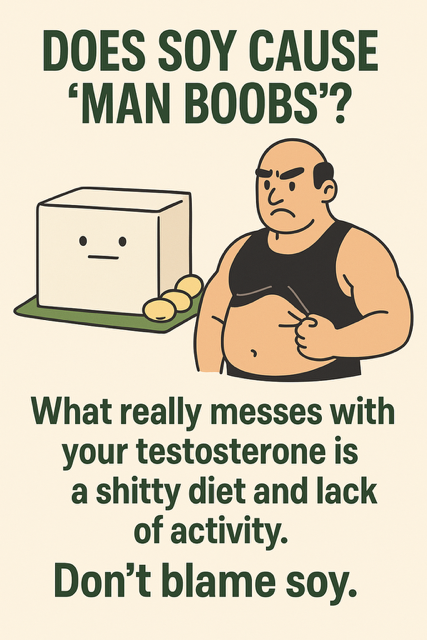
AI generated….and accurate
🧬 Equol — The Gut Connection
When soy is digested, daidzein (an isoflavone) can be converted into equol — a more bioactive compound that binds strongly to ER-β receptors - discussed above.
But only about 30–50% of people are “equol producers.”
That depends on gut microbiome diversity, fiber intake, and overall diet quality.
So, soy benefits may vary slightly between individuals — another reason whole health and gut health matter.
💪 Real Benefits from Real Food (adding more plants in your diet, example: soy)
✅ Cancer Prevention: Associated with lower incidence and recurrence rates.
✅ Heart Health: Improves cholesterol and arterial function.
✅ Bone Support: Reduces bone loss post-menopause.
✅ Menopause Relief: May ease hot flashes by modulating estrogen receptors.
✅ Anti-Inflammatory: Helps reduce oxidative stress and inflammatory markers.
⚠️ Quick Caveats
Whole foods win. Isoflavones act synergistically with soy’s fiber, protein, and fatty acids.
Supplements ≠ food. High-dose isoflavone capsules don’t replicate the same effects.
Context matters. Replacing processed meats with soy foods delivers the strongest benefits.
“Isoflavones — or soy — aren’t out here rewriting your hormones or about to turn you into Hulk or Barbie.”
🔁 The Bigger Lesson — You Can’t Work Against Biology
If you’ve been following along since The Fire Within post last week, this probably sounds familiar.
Remember the β-carotene studies — when researchers tried to prevent cancer with supplements and ended up increasing it? That’s the same lesson here. You can’t outsmart human physiology. I use this example a lot to try to drive home that over supplementation can be dangerous and it’s about balance and the whole health picture.
You can’t isolate a nutrient, overdo it, or avoid it entirely and expect your body to thrive.
Biology is built for balance — not extremes. Soy works with your biology when it’s eaten in its natural form — tofu, tempeh, edamame, soy milk — as part of a diverse, whole-food diet.
And like anything in nutrition, it’s about finding what works for you. I’ll be honest — I’m not a huge fan of tempeh… but I tried it! Also, tofu can be a texture adventure, but it takes on whatever flavor you cook it with….so positives there 😁
My personal favorite? Edamame. Easy, quick, high in protein — and it’s the one soy food that never lets me down. 🫘💪
🤔 Why Nutrition Gets So Messy
Because science happens in layers — and headlines skip straight to the punchline.
Animal studies show how something might work. Human studies show what actually happens (as long as it’s ethical).
So before you fall for another “Soy linked to cancer!” headline, ask:
Was it done in humans or mice?
What dose did they use?
What else were participants eating?
And my favorite: Who funded it? 💰
Here’s the truth: nutrition science is complex, and that’s exactly why we have researchers — to do the hard work of studying, testing, and refining what we know. But when media outlets cherry-pick a dramatic line for clicks, it confuses the public and undermines real progress.
We have to trust the process — trust the science, trust the researchers, and trust qualified medical professionals who read the studies and interpret them accurately. Evidence-based practice isn’t trendy — it’s essential.
Headlines might sell fear, but science builds understanding. 🔬💚
🌿 The Whole Health Connection
Just like with antioxidants, this all comes back to whole health.
Your body doesn’t operate in silos — nutrition, movement, sleep, stress, and mindset all interact.
Eating soy won’t “cure” anything, but incorporating whole soy foods can support:
Heart health through improved cholesterol ratios
Hormone balance through consistent plant protein and fiber
Cell protection by reducing oxidative stress
Overall resilience through better metabolic and inflammatory control
When you take care of the whole picture — not just single nutrients — your body does exactly what it’s built to do: protect, repair, and thrive.
🩷 Closing Out Breast Cancer Awareness Month
As this month comes to an end, let’s carry the message forward — awareness isn’t just for October.
Nutrition is one piece of a much larger story that includes movement, sleep, mental health, and community.
So whether you’re a survivor, a supporter, or simply someone trying to live well, remember:
Whole-body health is powerful! It doesn’t just prevent disease — it builds strength from the inside out.
🥗 The Real-World Takeaway
🌱 Whole soy foods are safe — and beneficial. Tofu, tempeh, edamame, and soy milk belong in a healthy, balanced diet — even for breast-cancer survivors.
💊 Supplements aren’t substitutes. Concentrated soy powders or isoflavone pills aren’t the same as food.
🧠 Context is everything. Health isn’t about one ingredient — it’s the sum of your choices, day after day.
🎗️ Empower, don’t fear. Nutrition should help you feel capable — not cautious.
💬 Chase Talk
I’ve seen cancer up close — my grandmother, my grandfather, my son, my uncle and many other close friends. Cancer does not discriminate and it has impacted every single one of us.
That’s why I take the science personally. Food won’t “cure” cancer, but it can absolutely support healing, strength, and resilience. I always keep this in mind when I make meals for my family.
So, if you want to do something good for your body:
👉 Toss edamame on your salad.
👉 Stir-fry tofu with colorful veggies.
👉 Sip some green tea.
Balance and variety are key!
And remember — nutrition isn’t about perfection. It’s about patterns. Try a meatless Monday where you can increase plant-based protein or have your lunches be plant based. Baby steps!
That’s how you truly Chase Your Health. 🌿
🫘Nutrition Spotlight: Edamame — Why I’m Basically Its Spokesperson
At this point, I talk about soy so much it owes me royalties.
“Chase says: More Edamame!” — sponsored by soy, powered by fiber and maybe some Diet Coke…
Let’s look at why it’s earned its place in your bowl.
Nutrient Amount per 1 cup cooked (≈ 160 g): understand that sources can differ somewhat but overall it’s well-balanced.
Calories ~224 kcal
Moderate energy for meals/snacks
Protein ~18 g
Complete plant protein — all essential amino acids
Fiber ~8 g
Gut health + blood-sugar control
Fat ~12 g (mostly unsaturated)
Heart-healthy fats
Carbs ~14 g (3 g sugars)
It’s nutrient-dense, gluten-free, cholesterol-free, and one of the easiest ways to add plant protein, fiber, and healthy fats to your diet.
🧾 References
American Cancer Society (2023). Soy and Breast Cancer: Myths and Facts. cancer.org
American Institute for Cancer Research (2024). Soy and Cancer Prevention. aicr.org
Messina M. (2016). Complementary Therapies in Medicine, 25, 47–53.
Jenkins D. J. A. et al. (2022). Annual Review of Nutrition, 42, 77–100.
Healthline (2024). Edamame Nutrition Facts and Health Benefits. healthline.com