
Stress has a Pulse
Stress Isn’t Just in Your Head. It’s in Your Heart, too.
We love to talk about heart health in numbers.
Cholesterol.
Blood pressure.
A1c
Weight.
All important.
But here’s what we don’t talk about enough: Chronic stress is a cardiovascular risk factor.
And let me tell you — in this day and age… we all have some stress.
Deadlines
Bills
Childcare, child, children…. all the kids
Jobs
Cleaning the damn house, then cleaning it again after 1 day…
What are we making for dinner tonight… and tomorrow… and for the rest of our lives?
Some of us are on SSRIs. Some of us probably should be (wink). I’m on one — and if I don’t take it, it shows. That’s not weakness. That’s modern life. We live in a fast-paced society that rarely powers down! And this Father, Husband, dedicated Dietitian has some stress!
Unfortunately, chronic stress remains one of the most overlooked pieces of whole health — especially when it comes to the heart.
Stress Is a Whole-Body Event
Stress isn’t just a thought.
It’s a cascade.
When your brain perceives pressure — deadlines, caregiving, financial strain, relationship tension — your body activates survival mode.
That means:
Increased cortisol (more on that in future blogs)
Elevated adrenaline
Higher heart rate
Blood vessel constriction
Rising blood pressure
Increased inflammation
Altered blood sugar regulation
Short-term? Protective.
Long-term? Damaging.
When the stress switch never flips off, your cardiovascular system stays in overdrive.
A Lesson from Why Zebras Don’t Get Ulcers
There’s a book called Why Zebras Don’t Get Ulcers by Robert Sapolsky.
Full transparency — I haven’t read it yet (because, ya know… stress and deadlines). But a pharmacist friend of mine gave a presentation on it and the message stuck.
When a lion chases a zebra, the zebra’s stress response activates — fight or flight. If the zebra survives, its stress response returns to baseline. It goes back to eating grass like nothing happened.
What do we do?
We are always running from the damn lion.
Except our lions look like:
Unread emails.
Financial pressure.
Childcare logistics.
Work expectations.
Social comparison.
And the stress response never fully shuts off.
That’s where wear and tear begins.
Chronic Stress = Chronic Wear & Tear
There’s a term for this: allostatic load — the cumulative burden of chronic stress on the body.
Over time, this contributes to:
Hypertension
Insulin resistance
Visceral fat accumulation
Endothelial dysfunction (impaired blood vessel health)
Increased cardiovascular event risk
This isn’t weakness.
This isn’t “not coping well.”
This is biology responding to sustained demand — in a culture that has normalized overload.
The Mental Load Has a Pulse
For many women — especially working moms — stress isn’t dramatic.
It’s constant:
Being the default parent
Managing the family calendar
Coordinating meals, school forms, appointments.
Carrying emotional labor
Balancing professional expectations
Showing up for everyone else while pushing yourself to the bottom of the list
It doesn’t look like collapse. It looks like functioning exhaustion.
And the nervous system still feels it.
We cannot talk about heart health without acknowledging invisible labor and chronic stress load.
Race, Women, and Cardiovascular Risk
Chronic stress is not evenly distributed.
In the United States:
Black women have significantly higher rates of hypertension than white women.
Black women are more likely to experience earlier onset cardiovascular disease.
Maternal mortality — often tied to cardiovascular complications — disproportionately affects Black women.
Structural stressors matter. Discrimination matters. Economic instability matters.
When we reduce heart health to “eat better and move more,” we ignore the systemic drivers of chronic stress.
Whole health requires context.
And it requires systemic change.
Whole Health Means Zooming Out
You cannot run or out-eat chronic stress.
Yes:
Fiber supports cholesterol.
Omega-3s support inflammation.
Movement improves vascular health.
But if someone is:
Sleeping 5 hours a night
Skipping meals
Running on caffeine
Never off the clock
Emotionally depleted
Their cardiovascular system is still under strain.
Whole health means asking: What’s happening in your life — not just what’s on your plate?
So What Actually Helps?
For one — do not say “just relax” to the women in your life.
We do not shame them. We support them.
What moves the needle:
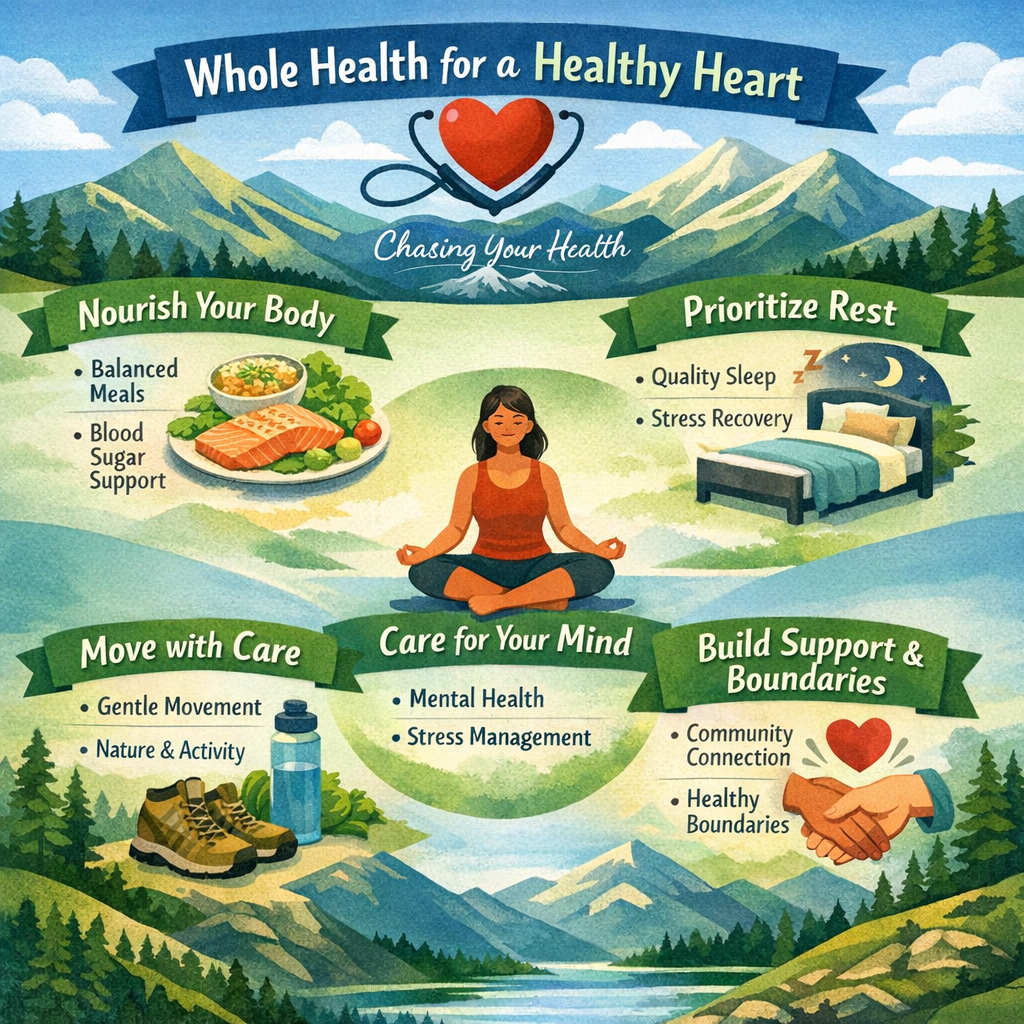
Consistent, adequate nourishment
Sleep support (even small improvements matter)
Movement that regulates, not punishes
Stable blood sugar patterns
Social connection
Boundaries
Delegation
Mental health care
Realistic expectations
Sometimes the most heart-protective intervention is reducing pressure — not adding another rule.
The Chasing Your Health Reflection
Stress isn’t just emotional. It’s physiological.
It shapes inflammation.
It alters blood pressure.
It impacts blood sugar
It changes how blood vessels function.
But here’s the part I keep thinking about: We ask a lot of the women in our lives.
Historically, women carried the invisible load quietly.
This generation? They’re expected to carry it all — and excel professionally, look put together, stay fit, stay present, stay calm. That pressure doesn’t disappear just because someone is strong.
It accumulates.
And when stress accumulates, the cardiovascular system feels it.
Heart health isn’t just about what’s on her plate. It’s about what’s on her shoulders.
If we truly care about the women in our lives, we have to do more than tell them to “take care of themselves.”
We have to:
Share the mental load
Normalize rest
Check in without trying to fix
Reduce pressure where we can
Stop glorifying burnout!!
That whole “work hard, play hard” mantra? It needs to retire FOREVER.
When you’re on the clock — absolutely, show up. Work hard. Strive for excellence. Take pride in what you do.
But when you’re off the clock, you deserve to be off.
You deserve rest. Joy. Presence. Space to breathe.
Work-life balance isn’t lazy. It’s protective.
And yet, in our fast-paced culture, it’s often treated like a luxury instead of a necessity.
I say this with hope — that more of us can build lives where recovery is normal, not earned.
But I also know that not everyone’s 24 hours look the same.
A mom raising three kids while working two jobs to make ends meet is navigating a completely different reality than mine.
That’s why this conversation isn’t just about individual choices — it’s about societal structure.
My hope is that one day, we create systems that truly see you, support you, and stop asking you to survive at full speed forever.
Because hearts were never meant to live in constant overdrive.
I’ll say this too.
On President’s Day, we went to the zoo. And I couldn’t help but notice — it was mostly moms.
Moms juggling multiple kids, strollers, snack bags, bathroom breaks, and trying to burn off just enough energy so maybe bedtime goes a little smoother later.
There weren’t many dads there flying solo. I’m sure many were at work. That’s real.
But it was still a reminder that the old patterns haven’t fully disappeared. The expectations may be evolving, but the load still often lands in the same place. And that matters when we talk about stress.
However, there is progress happening.
Research shows that millennial fathers are spending more time with their children than generations before them. Many men are more involved in daily caregiving, school events, bedtime routines, and emotional presence than their fathers were.
That matters.
But involvement isn’t the same as equity.
Women still tend to carry the invisible load — the planning, the coordinating, the remembering, the emotional management.
And that’s where stress accumulates.
I do believe many of us men are trying to do better than our fathers — and their fathers before them. Trying to show up, not just stand on the sidelines. Trying to be in the chaos, not just observe it.
The goal isn’t perfection. It’s partnership.
Because when support increases, stress decreases.
And that’s good for everyone’s heart.
At Chasing Your Health, we see you.
Whole health means supporting the human behind the lab values.
Because stress doesn’t stay in the mind.
It settles in the body.
And if we want healthier hearts, we need healthier expectations — especially for the women carrying so much.
I’m looking at myself too. I know I could do better.
My wife carries a burden — logistical, emotional, invisible — that I don’t always fully see in the moment. And while I try to show up, I know there are still ways I can lighten that load.
— Chase M, MS, RDN, LN, CSR