

Every time the Dietary Guidelines for Americans get updated, two things happen:
Dietitians read the actual document.
The internet reads one sentence, misunderstands it! What we didn’t expect is everyone declares butter the chosen one.
This year’s update was no exception.
Suddenly my feed looked like:
“Seed oils are cancelled.”
“Butter is BACK.”
“Protein was under attack and now it’s free.”
Food dyes bad
Fiber ok but not emphasized
Non-nutritive sweeteners should be avoided
Alcohol has free reign!
Let’s talk about what the new dietary guidelines actually mean — and what nutrition science absolutely did not forget.
Did the Guidelines Change?
Barely. — but honestly, in some ways they just got worse.
Compared to the 2020 guidelines, this update leans into:
“Eat real, whole foods”
Fewer ultra-processed foods
Simpler, food-based language
Less rigid “diet pattern” talk
And let me be clear — dietitians have been saying this for YEARS.
Have you ever gone to a doctor or your friendly neighborhood dietitian and heard:
“Please eat more chips and candy, we promote that.”
Absolutely not!
But do we punish people for indulging?
Also no. Moderation, people.
This isn’t new information. This is a re-brand, pushed by a burnt-out old man trying to position science-based organizations as “the enemy.” RFK Jr. wants the public to believe that established health organizations are pushing sugar and processed foods.
That has never been the case!!!!
What has happened is this:
Americans choose processed foods over vegetables most of the time
Access to healthcare is poor
And it just got worse after Republicans ended ACA subsidies
“You can’t make America healthy again if people can’t afford to see a doctor”
Health doesn’t improve because you yell “butter good” into the void .
Butter & Beef Tallow: Promoted?
Let’s be very clear before the internet combusts with comments on this.
Butter and beef tallow are still:
High in saturated fat
Still capable of raising LDL cholesterol
Still not cardioprotective when compared to unsaturated fats
No guideline — past or present — says:
“Saturated fat no longer affects cholesterol.”
That memo never went out apparently….
The Science Didn’t Change (Sorry not sorry)
Here’s the part people keep skipping.
Saturated fat:
➡️ Raises LDL cholesterol
➡️ Elevated LDL cholesterol causes atherosclerosis
➡️ Atherosclerosis leads to cardiovascular disease
That’s not diet culture.
That’s cardiology 101.
Organizations like the American Heart Association and the World Health Organization still recommend keeping saturated fat under ~10% of calories — not because they hate joy, but because they like arteries and promote heart health.
Now let’s talk about the 10% of calories from saturated fat guideline — which, by the way, is the same target as previous Dietary Guidelines. Nothing new here.
So this is where things get… confusing.
If the messaging now promotes more saturated fat and more animal protein, we have to ask an obvious question:
Can those two recommendations realistically coexist?
Because the math hasn’t changed…
What 10% Saturated Fat Actually Means
On a 2,000-calorie diet:
10% of calories = 200 calories
Fat provides 9 calories per gram
200 ÷ 9 = ~22 grams
✅ That’s about 22 grams of saturated fat per day
That’s exactly why organizations like the American Heart Association continue to recommend keeping saturated fat low. They actually promote less than 6% or 13gm of saturated fat per day on a 2000 calorie diet.
Why This Gets Tricky in Real Life
Because saturated fat adds up fast:
1 tablespoon butter ≈ 7 g saturated fat
A large cheeseburger ≈ 10–12 g
A 10oz steak dinner + butter + glass of Whole Milk - can blow past 13 g /22 g before you even realize it…
So when we encourage more animal fats without addressing limits or trade-offs, we’re left with mixed messaging — and cholesterol labs that may not be thrilled about it.
Butter didn’t suddenly stop doing what butter does….and what it does is raise your risk of cardiovascular disease when eaten in excess.
The Plot Twist Everyone Ignores: Replacement Matters
When saturated fat is reduced, outcomes depend on what you replace it with.
Replace saturated fat with refined carbs → 🫤 minimal benefit, if any
Replace it with sugar → 😬 sometimes worse
Replace it with unsaturated fats → 🎉 lower LDL and fewer cardiovascular events
So when someone says:
“Saturated fat isn’t bad!”
The correct follow-up is:
“Compared to what?”
Nutrition is not a courtroom drama — context matters and so does the science!
What the Evidence Still Supports: Plants + Mediterranean Style Eating
Despite the noise, decades of research consistently support dietary patterns that:
Are lower in saturated fat- You’re welcome steers…. (Male cattle that have been castrated for those readers who may not know, steers are the preferred production of those steaks)
Emphasize plant-based foods
Use unsaturated fats as the primary fat source
Plant-forward diets are associated with:
Lower LDL cholesterol
Lower ApoB ( a protein found on the surface of the cholesterol-carrying particles that are most strongly linked to heart disease.)
Reduced cardiovascular disease risk
And then there’s Mediterranean-style eating — vegetables, fruits, legumes, whole grains, nuts, seeds, olive oil, fish, modest dairy — which remains one of the most evidence-backed dietary patterns for heart health — and low in red meat.
This isn’t trendy. It’s boring, repeatable, studied, excellent science.
A Very Short Timeline of Saturated Fat & Heart Disease Research 🕰️
Because this didn’t start on TikTok.
1950s – The Question Emerges
Researchers notice rising heart attack rates in Western countries and begin examining diet.
Early population studies suggest higher saturated fat intake is linked with higher heart disease rates.
👉 This is where the question starts — not the conclusion.
1958 – Framingham Changes Everything
The Framingham Heart Study begins following thousands of people over decades.
Key discoveries:
LDL cholesterol predicts heart disease
Diet influences LDL
Saturated fat raises LDL
This study essentially builds modern cardiovascular prevention.
1960s–1970s – Metabolic Ward Studies
Scientists tightly control diets in research settings (every bite measured).
They consistently find:
Saturated fat raises LDL cholesterol
Replacing saturated fat with polyunsaturated fat lowers LDL
This establishes biological cause-and-effect, not just associations.
1980s–1990s – Clinical Trials
Randomized trials show:
Diets lower in saturated fat reduce cardiovascular events
Benefits are strongest when saturated fat is replaced with unsaturated fats (not sugar)
Guidelines worldwide start forming based on this evidence.
2000s–2010s – Meta-Analyses & Nuance
Large reviews confirm:
Saturated fat raises LDL
Cardiovascular benefit depends on what replaces it
This is where confusion online begins — not because the science changed, but because context gets lost.
2017 – Major Consensus Review
The American Heart Association publishes a presidential advisory reviewing decades of research.
Bottom line:
Replacing saturated fat with polyunsaturated fat reduces cardiovascular disease, and LDL is causal for atherosclerosis.
This wasn’t a new opinion — it was a summary of ~70 years of data.
2020s – Genetic & Causal Evidence
Modern tools (like Mendelian randomization) confirm:
LDL cholesterol causes atherosclerosis
Saturated fat raises LDL
Lowering LDL lowers cardiovascular risk
At this point, the evidence is converging from multiple directions.
The Takeaway
Saturated fat didn’t suddenly become controversial.
It’s been studied for over seven decades, using:
Population studies
Controlled feeding trials
Randomized clinical trials
Genetics
That’s not “weak nutrition science.”
That’s one of the most robust evidence chains we have in diet and disease.
“Saturated fat has been studied since the 1950s. It didn’t just start raising LDL last year.”
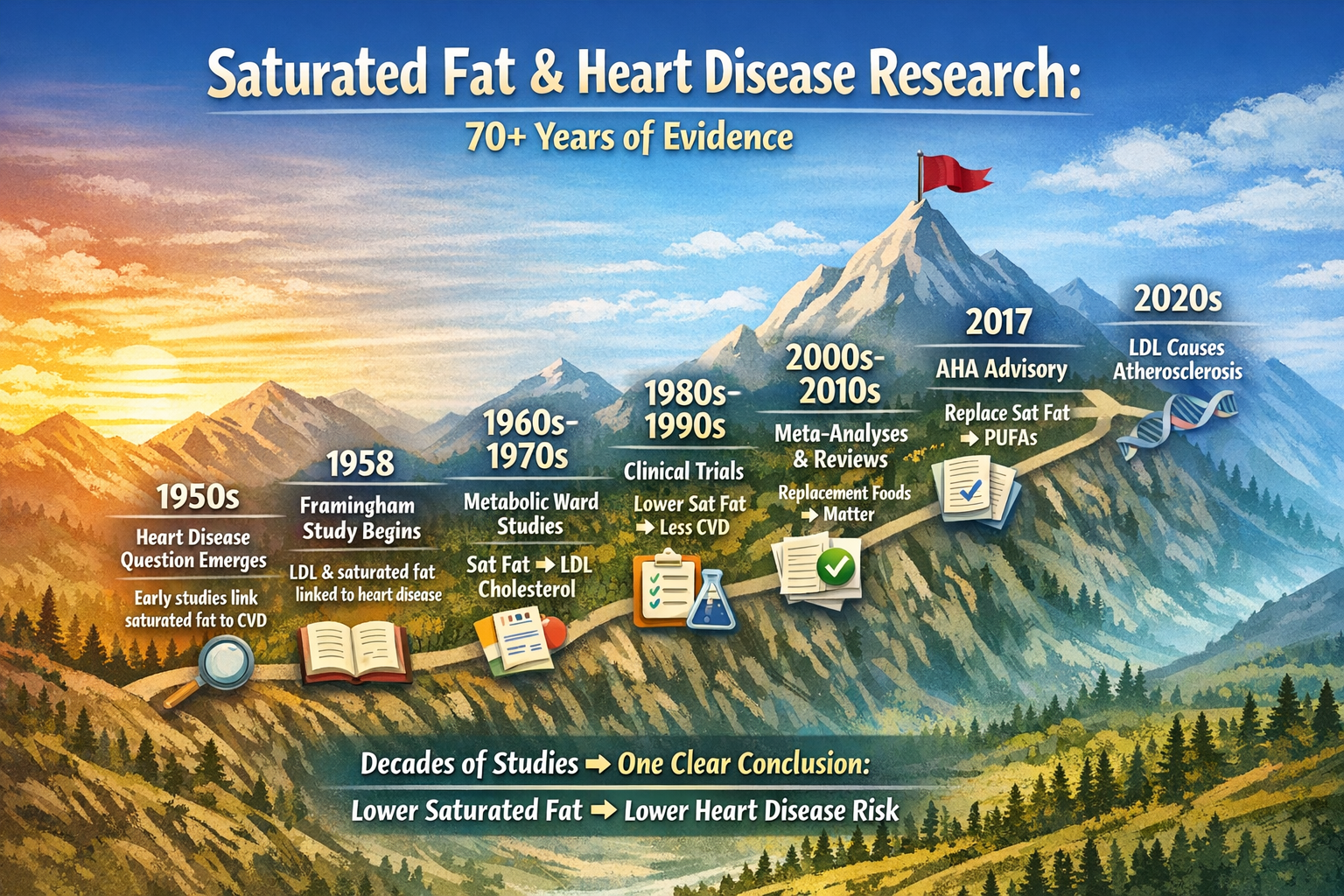
Saturated Fat Research Timeline
Now, I know you can’t tell by reading but I’m getting worked up.. lol Now let’s talk about RealFood.gov, because they dropped a line that deserves its own paragraph.
“We’re Ending the War on Protein”… I’m Sorry, WHAT?
The site proudly announces:
“We are ending the war on protein.”
I had to read that twice. Because… when was there a war?
Americans are obsessed with protein.
We add it to coffee.
We argue about it online.
We’ve turned it into ice cream, cereal, and cookies.
ETC!!
If there was a war on protein, protein:
Won
Took a victory lap
Got its own aisle at Costco
The real issue has never been protein scarcity.
It’s been:
Protein crowding out fiber
Protein being treated like a personality
Protein being used to justify diets that forgot vegetables exist (Atkins, Keto)
Yes — adequate protein is important.
Yes — higher protein intakes are fine and appropriate for healthy adults. In fact, I’m all for higher protein in healthy humans!
But framing this as “ending a war” feels less like policy and more like:
“We noticed Americans already love protein, so let’s put it on a parade float.” And the guy in charge just painted over the old float with a pizza looking, stupid ass, pyramid AGAIN!
“Oh Good. They Made a New Food Pyramid. Because the Last One Went So Well!”
If you grew up staring at the old food pyramid wondering why bread was the foundation of human existence — congratulations, we’re back ish. Except now steak, beef tallow and butter are top dogs!
Yes. The new dietary guidelines introduced a brand-new food pyramid.
Because nothing says “nutrition clarity” like resurrecting a graphic we collectively roasted for 30 years. See the older pyramids below:
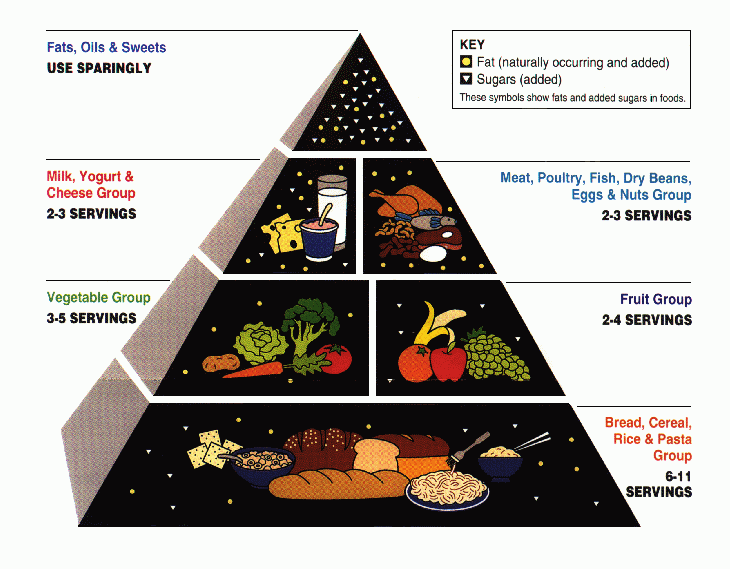
The old Pyramid.. stupid (1992)
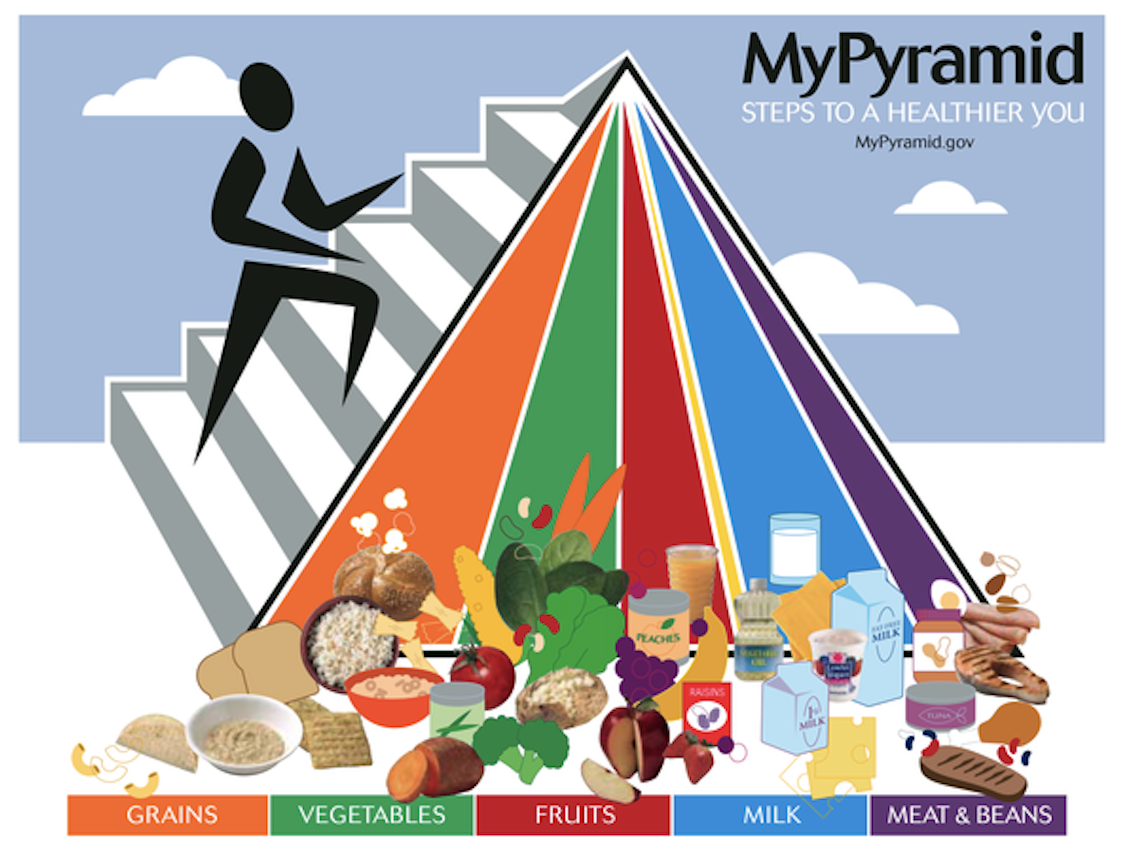
I like the activity part.. but doesn’t show how to balance.. so it too is stupid (2005)
What the New Food Pyramid Looks Like
Picture this “a pizza slice”:
1/2 your slice is Protein
Meat, poultry, eggs
Dairy - whole milk … bring on the full fat dairy 🥛
Seafood
Other side is:
Vegetables & fruits - excellent
Middle (fats):
Saturated … sweet sweet butter and beef tallow make the cut
Avocado and olive oil are still on which is great
Thinnest part of the slice
Whole grains (noticeably less dominant)
The vibe: We don’t eat fiber now so why push more whole grains
Visually, it’s a pizza slice made of clip art and gives the reader no idea how to take this and create a healthy meal pattern.
Side note: at first I didn’t realize it looked like pizza, shame on me, but my coworkers husband instantly said pizza slice and I commend his brain (Dylan you know who you are)!
And Yes… There’s a Big Ol’ Steak on the Pyramid 🥩.. Why wouldn’t there be!?
We need to talk about the steak. Because it’s big enough to make a statement — proudly perched like it pays rent — it’s a giant steak.
Not fish.
Not beans.
Not lentils.
A full-on cartoon steak, staring at you like:
“I am the foundation now.”
It’s giving:
Protein is king - which again I don’t disagree I love Protein as part of the balance
Fiber is optional
Cholesterol panels are not part of the equation apparently
And perhaps the beef industry gave a little money to put that there??? 🤷♂️ maybe this helps them out since them there tariffs didn’t go so well….
Steak isn’t evil.
But when your national nutrition graphic looks like it was sponsored by Big Grill™, we’re allowed to raise an eyebrow.
📌 Authors with Beef/Dairy Industry Connections
Based on the disclosures in the PDF:
✅ J. Thomas Brenna — Travel supported by a dairy industry platform.
✅ Donald Layman — Ties to the National Cattlemen’s Beef Association and dairy-related speaking engagements.
✅ Unnamed contributors (via their research funding) — Projects funded by dairy industry sources (e.g., California Dairy Research Foundation, Dairy Management Inc.) related to dairy co-products and milk components.
🧠 Why This Matters for Potential Bias
Experts with industry ties — especially to beef and dairy organizations — can potentially influence recommendations (even unintentionally) because:
Industry sponsorships are associated with more favorable interpretations of evidence about those products.
Compensation (even travel, honoraria, or research funding) can create perceived or real conflicts of interest in advisory roles.
In this report, at least two reviewers have clear ties to beef/dairy industry groups and others are funded for dairy research — which may influence emphasis on those food groups or interpretations of related evidence.
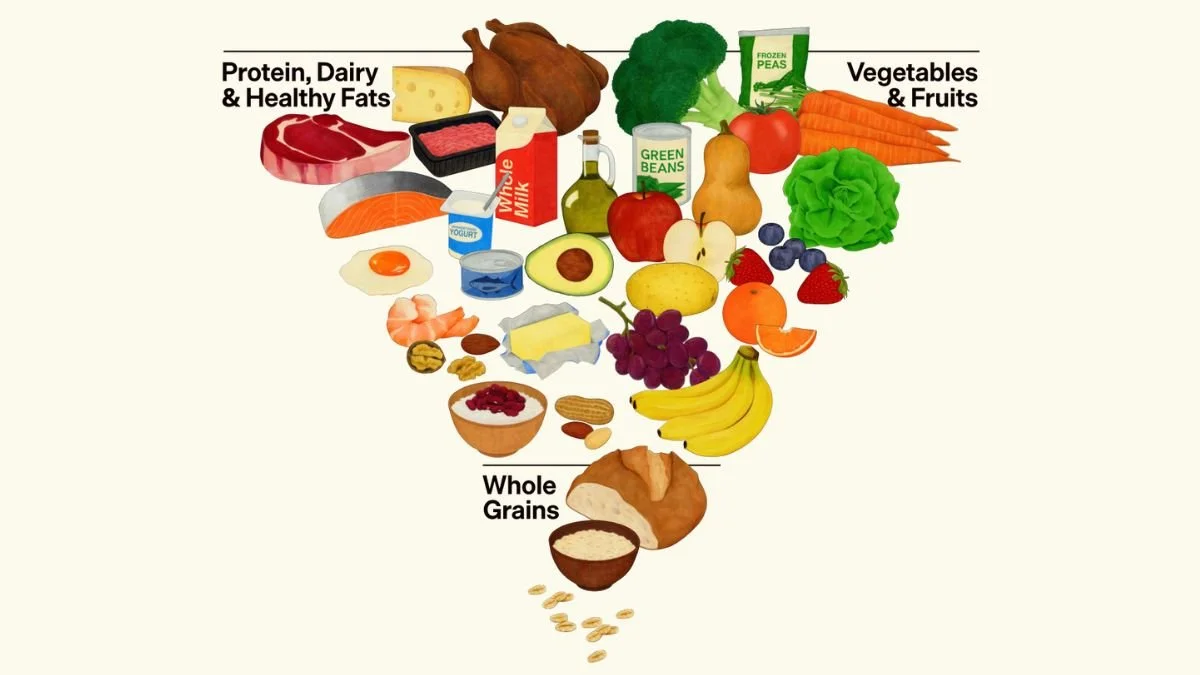
The New Pyramid… again stupid….It looks like an old man who finally figured out how to use clipart, in a word document, threw this together.
MyPlate (The Calm Adult in the Room)
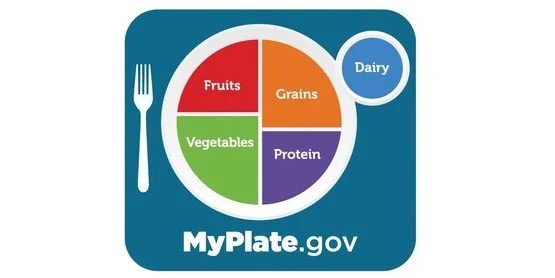
An actual plate depicting meal planning.. on point
Now compare that chaos to MyPlate, created by the USDA in 2011 after retiring the original pyramid BECAUSE… it confused everyone!
What MyPlate Does Better
Shows proportions, not hierarchy
Encourages balance, not dominance
Works on an actual plate
Doesn’t crown one food group ruler of the kingdom
Half your plate:
🥦 Fruits & vegetables
One quarter:
🌾 Grains (preferably whole)
One quarter:
🍗 Protein
Plus:
🥛 Dairy on the side
MyPlate wasn’t meant to be perfect — it was meant to be understandable, teachable, and usable in real life. One plate. One glance. No geometry degree required.
It’s boring.
It’s practical.
It works.
Which is exactly why it doesn’t go viral.
Pyramid vs. Plate: The Real Issue
Pyramids “aka the pizza slice” imply:
One “foundation” food
A hierarchy of moral value
One-size-fits-all eating
But health doesn’t happen in triangles.
MyPlate quietly acknowledges something the pyramid ignores: People eat meals, not diagrams.
So… Can You Eat Butter?
Yes. Please relax.
Butter:
Is flavorful
Has a place
Is not a health supplement
If your diet is:
Mostly whole foods
Rich in plants, fiber, and unsaturated fats
Balanced overall
Butter can absolutely exist.
If butter and beef tallow is the strategy for your health…. Your cholesterol panel may disagree and so does the science.
Other Topics the Guidelines Touched… Lightly (and Sometimes Sideways)
Food Dyes:
Let’s start with food dyes. Most of us can agree—we don’t need them. The Dietary Guidelines suggest limiting foods with artificial colors as part of reducing highly processed foods, and honestly, fine. No one is fighting for Red 40. But let’s not pretend this is some massive nutrition win. Swapping petroleum-based dyes for beet juice doesn’t magically upgrade the product. A red Skittle made with “natural coloring” is still a fucking Skittle. It’s still ultra-processed, still mostly refined carbs and added sugar, and still doing nothing meaningful for your health. Changing the color doesn’t change the nutrition. If we actually care about health outcomes, the focus should be on how much ultra-processed food we’re eating—not how aesthetically pleasing the ingredients list looks.
Non-nutritive sweeteners:
Then we get to non-nutritive sweeteners, which the Guidelines also encourage people to avoid. Again—fair, to a point. No one is calling diet soda a health food. But demonizing non-nutritive sweeteners ignores reality. For many people, they are a useful alternative that helps reduce added sugar intake, manage calories, and control blood sugar. Are they perfect? No. Are they better than chugging real sugar all day? Yes. Absolutely. Somehow we’ve reached a place where diet soda is treated like the enemy, while we’re supposed to celebrate that Coke is back to “real sugar.” Now people can enjoy McDonald’s with a large cane-sugar Coke. A true win for MAHA. Nothing says metabolic health like ultra-processed food paired with a nostalgia-sweetened sugar bomb.
Alcohol:
And finally… alcohol. This is where things really get weird. No clear limits. No firm recommendations. Just kind of a shrug. Frat Boy Chase is ecstatic. Dietitian Chase is staring at the page asking what the hell just happened. Alcohol is a known carcinogen at higher intakes, with strong links to cancer risk, liver disease, hypertension, and disrupted sleep. Yet somehow it escapes the same level of scrutiny as food dyes and diet soda. If we’re going to talk about health-first guidelines, shouldn’t a substance with clear dose-dependent cancer risk warrant stronger guidance? It’s a strange hierarchy when we’re micromanaging sweeteners but giving alcohol a free pass.
Final Thoughts
The Guidelines spend a lot of energy zooming in on ingredients—food dyes, non-nutritive sweeteners, and vague warnings about “processed foods.” Meanwhile, the bigger picture quietly fades into the background. What actually drives health outcomes isn’t whether your candy is dyed with beet juice or Red 40, or whether your soda has aspartame or sugar—it’s overall dietary patterns, total added sugar intake, fiber intake, physical activity, sleep, stress, and yes, alcohol consumption. We’re arguing over paint colors while the house is on fire. Focusing on ultra-processed foods as a category makes sense. Policing individual additives while ignoring clearly established risks—like excessive alcohol intake—does not. Nutrition science works best when we stop chasing villains and start addressing behaviors that actually change health.
If you take anything away from this blog, let it be this: cleaner junk food is still junk food. Non-nutritive sweeteners aren’t health foods, but they’re also not the enemy. Natural food dyes don’t turn candy into produce. And alcohol doesn’t become harmless just because the Guidelines got awkwardly quiet about it. Real progress in public health doesn’t come from aesthetic ingredient swaps or nostalgia-driven policy changes—it comes from honest, evidence-based guidance that prioritizes patterns over purity. We don’t need perfect foods. We need better context, better balance, and fewer nutrition culture wars fueled by vibes instead of science.
The new dietary guidelines didn’t overturn decades of cardiovascular scientific research.
They didn’t cancel seed oils.
And they definitely didn’t mean “science was wrong.” They just want to be the heroes despite the real MVPs (scientists, health professionals, health organizations) already doing the work.
The narrative is still great but it’s not new by any means:
Eat more real food
Stop letting ultra-processed junk dominate your diet
Use common sense — and actual evidence
And maybe…Let fewer politicians write nutrition fan fiction.
Let’s chase our health — not headlines. 🏔️💚 Listen to your health professionals!
— Chase MS, RDN, LN, CSR —You bet your ass I added my credentials on purpose here lol
✅ Health Organization Statements & Reactions
1. American Heart Association (AHA)
The AHA issued a statement welcoming parts of the new guidelines while urging continued focus on established science-based nutrition advice (e.g., limiting added sugar, sodium, and saturated fats). They also highlighted areas of concern about some recommendations.
🔗 Full statement — American Heart Association:
2. Academy of Nutrition and Dietetics (AND)
The professional organization for dietitians released its Academy Statement on the 2025-2030 DGAs, outlining both support for nutrient-dense food recommendations and concerns where guideline choices diverge from established evidence.
🔗 Full statement — Academy Statement on 2025-2030 DGAs Release:
3. Meals on Wheels America
This nonprofit coalition issued its own response, focusing on implications for senior nutrition programming and noting both opportunities and gaps in how the guidelines address older adults’ needs.
🔗 Full statement — Meals on Wheels America:
4. Physicians Committee for Responsible Medicine (PCRM)
The PCRM (advocating plant-based dietary patterns) released a commentary critical of certain guideline recommendations—especially increased emphasis on animal proteins and full-fat dairy.
🔗 Critical response overview — PCRM statement:
Graphic on the WAR ON PROTEIN!! brought to you by AI