

The Truth About Weight Loss: Beyond Calories
Weight management is often simplified into:
Eat less. Move more.
And while energy balance is foundational, modern research shows that body weight is regulated by a dynamic, adaptive system involving metabolism, hormones, brain signaling, and environment.
A 2022 review (Hall et al.) reinforces that energy balance governs weight change—but also highlights that the body actively defends weight through:
Changes in hunger hormones
Changes in energy expenditure
Behavioral adaptations
So yes—calories matter, but your body is constantly influencing how many calories you want, need, and burn.
Whole Health: The Systems Approach
Whole health is an approach to health and well-being that looks at the entire person—not just physical symptoms or disease—but also how lifestyle, mental, emotional, social, and environmental factors all interact to influence health—it’s the result of multiple systems interacting simultaneously.
Simple definition: Whole health = caring for your body, mind, and life as a system—not separate parts.
These include:
Endocrine system → hormones (insulin, leptin, ghrelin, cortisol)
Nervous system → brain reward pathways, stress response
Metabolic system → resting energy expenditure, thermogenesis
Behavioral system → habits, routines, decision-making
Environmental system → food access, stress exposure
A JAMA review (Stanford et al., 2020) emphasizes that effective weight management requires addressing these systems together, not in isolation.
👉 Clinical takeaway: If one system is dysregulated (sleep, stress, etc.), it will impact the others. Dietitians have been preaching this for many years, but unfortunately we all want that quick fix for weight loss.
Nutrition: More Than Calories
Energy intake matters—but food quality directly influences physiology. Basically, you can eat a lower calorie diet but if it’s all Oreos and pizza it won’t have the same impact on whole health as a nutrient dense foods within the same calorie range.
Ludwig et al. (2021) describe how nutrient dense food impacts:
Insulin response → affects fat storage and hunger
Satiety hormones → protein and fiber increase fullness
Energy expenditure → some diets may slightly alter metabolic rate
Mechanistically:
Protein → increases thermic effect of food + preserves lean mass
Fiber → slows gastric emptying + increases satiety signals
Refined carbs → rapid glucose spikes → insulin → quicker hunger return
👉 Practical translation: Two diets with equal calories can produce very different experiences in:
Hunger
Energy
Adherence
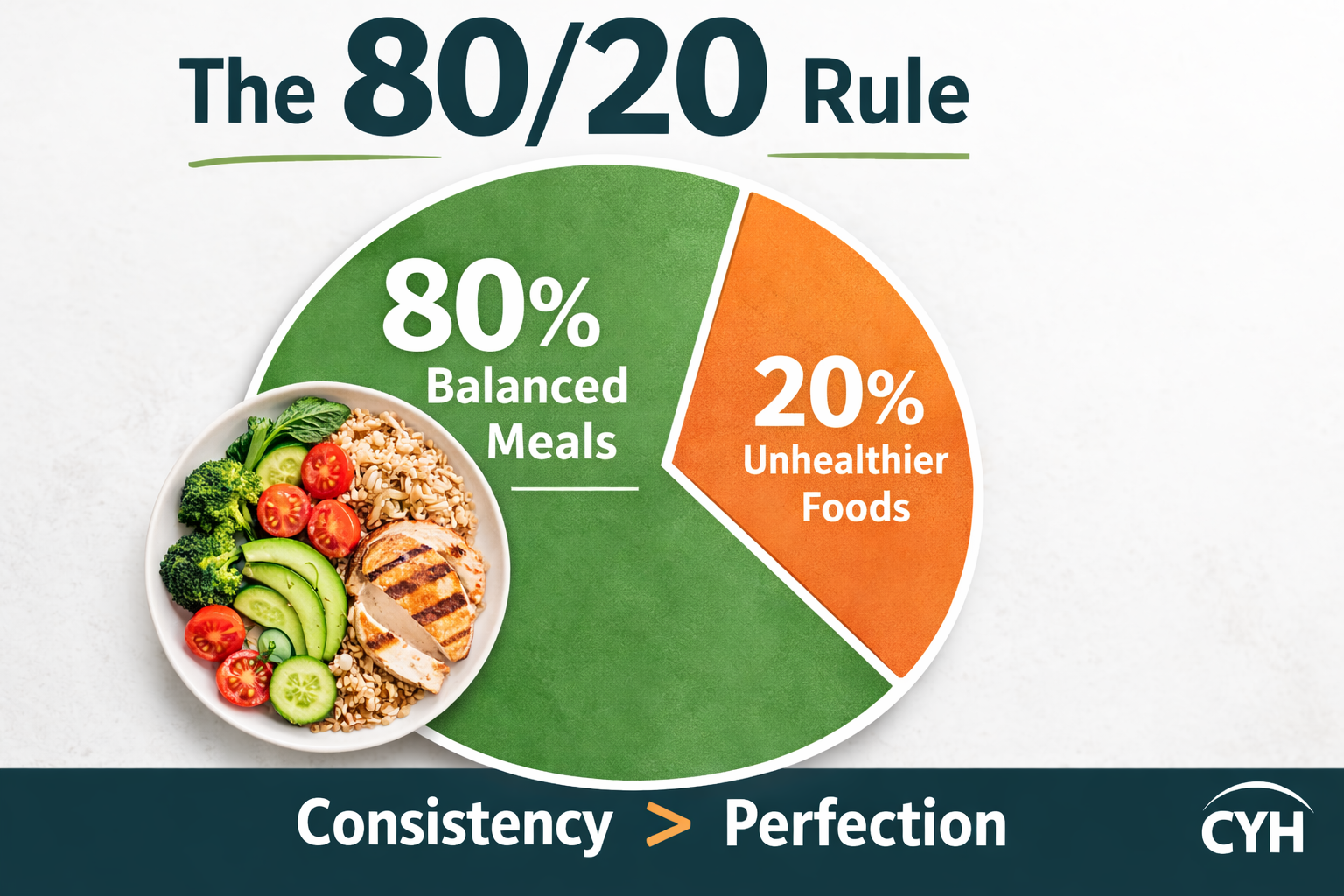
Which ultimately determines success. Remember, the 80/20 rule from the last post.. link below:
Sleep: Hormonal Regulation of Hunger
Sleep is one of the most powerful regulators of energy intake and metabolism.
Tasali et al. (2022) demonstrated that increasing sleep duration reduced caloric intake by ~270 kcal/day.
Why this happens:
Sleep deprivation alters key hormones:
↑ Ghrelin → increases hunger
↓ Leptin → decreases fullness
↑ Endocannabinoid signaling → increases desire for high-calorie foods- this system helps control appetite, energy balance, mood and reward/pleasure center.
Additionally:
Sleep deprivation reduces insulin sensitivity
Increases late-night eating behaviors
Reduces physical activity capacity
👉 Clinical insight: Sleep impacts both sides of energy balance:
Intake ↑
Expenditure ↓
Stress & Cortisol: How Your Body Shifts Into Survival Mode
Cortisol is often labeled as “the stress hormone,” but that undersells what it actually does.
It is part of a highly coordinated system—the HPA axis (hypothalamus–pituitary–adrenal axis)—designed to keep you alive.
In short bursts, cortisol is beneficial.
It helps:
Mobilize energy
Increase alertness
Maintain blood pressure
Prioritize survival functions
This is the same system that allowed humans to escape real threats—like predators - LIONS!
But as highlighted in Why Zebras Don’t Get Ulcers (I refer to this book a lot in my posts), the problem is that humans can activate this system chronically, without physical danger. Meaning… we are all chronically stressed… we never turn off the system…
And when cortisol stays elevated or becomes dysregulated over time, the effects shift from helpful… to harmful.
What the Research Shows
Modern research continues to support the connection between chronic stress and body composition.
Adam et al. (2020) demonstrated that disrupted cortisol rhythms—not just elevated levels—are associated with:
Higher BMI
Greater abdominal (visceral) fat accumulation
Epel et al. (2021) further showed that individuals with chronic stress patterns tend to exhibit:
Increased reward-driven eating
Greater central fat storage
Altered metabolic responses
This is a key point: 👉 It’s not just how much cortisol is present—it’s how often and how long your body is exposed to it.
I will have another post strictly just on cortisol in our next blog.
🧠 Mental Health & Eating Behavior
Eating isn’t just about hunger—it’s driven by your brain.
Your brain uses:
Dopamine → reward (“this feels good, do it again”)
Amygdala → emotions
Prefrontal cortex → control and decision-making
😵💫 What Happens Under Stress
Emotional center (amygdala) ramps up
Control center (prefrontal cortex) slows down
Result:
More impulsive eating
More cravings
Harder to stop
📈 What This Leads To
Emotional eating
Stress-driven food choices
Increased risk of weight gain over time
Metabolic Adaptation: Why Plateaus Happen
Weight loss triggers physiological adaptations designed to preserve energy.
Rosenbaum & Leibel (2020) describe what happens when you start to lose weight:
↓ Resting metabolic rate
↓ Non-exercise activity thermogenesis (NEAT) - this means the calories you burn during activities of daily living… all the movements throughout the day that aren’t intentional exercise. Thus ultimately decreases in responses to this whole system.
↑ Hunger signals
This is called adaptive thermogenesis, fancy word for your body being an asshole in response to weight loss, but a protective asshole.
Why it happens:
From a survival standpoint, weight loss = potential threat.
So the body:
Becomes more efficient
Burns fewer calories
Increases drive to eat
👉 This explains:
Dreaded Plateaus
Slower progress over time
Difficulty maintaining weight loss
Your body is wired for survival—not modern life.
From an evolutionary standpoint, it’s designed to store energy whenever it can. Back when food was unpredictable, that made sense. If you came across food, you ate it, stored the excess as fat, and used it later when food wasn’t available.
The problem is… our biology hasn’t changed, but our environment has.
Now we have constant access to high-calorie, highly palatable foods. So the same system that once kept us alive is now working against us—pushing us to eat, store, and repeat…
Genetics & Weight: You’re Not Starting From the Same Place
One of the biggest misconceptions in weight management is that everyone is playing the same game.
They’re not.
Genetics influence:
Baseline metabolism
Appetite and hunger signals
Fat storage patterns
Hormonal responses
How your body adapts to weight loss
Research shows that certain genetic variations can impact how strongly someone experiences hunger, how easily they store fat, and how their metabolism responds during weight loss.
👉 Translation: Some people have to work harder to achieve the same outcome.
But Genetics Are Not Your Destiny
This is where the conversation needs to be balanced.
Genetics may set the stage—but they do not write the entire story.
Lifestyle factors still play a major role:
Nutrition quality
Physical activity
Sleep
Stress management
Environment
In fact, many studies show that healthy behaviors can override genetic risk to a large extent.
Why This Matters
Understanding genetics helps shift the mindset from:
❌ “Why can’t I do this?”
to
✅ “What does my body need to succeed?”
Because weight management isn’t about comparing yourself to others.
It’s about understanding your physiology and working with it.
System Overload: When Everything Works Against You
Now combine:
Poor sleep
Chronic stress
Emotional strain
Calorie restriction
High exercise load
You create a compounding physiological burden:
Cortisol ↑
Hunger ↑
Recovery ↓
Metabolism adapts
This is why people feel like:
“I’m doing everything right, but nothing is working.”
They’re not failing—they’re overwhelming the system.
And that’s part of the reason long-term success becomes so difficult. They may be in a calorie deficit, but their body is adapting and pushing back—through increased hunger, reduced energy, and lower overall calorie burn.
I often tell my patients: if you’re not addressing your whole health—sleep, stress, and mental well-being—you’re making weight loss much harder than it needs to be.
The Integrated Model of Weight Management
Modern research supports a shift from:
“Calorie-only model”
to
“Integrated systems model”
Leading organizations like theWorld Health Organization and The Lancetrecognize obesity as a:
Multifactorial condition—not just a behavioral issue
That means weight is influenced by:
Biology (hormones, metabolism)
Brain and behavior
Stress and sleep
Environment and food availability
But Let’s Ground This…
All of this matters, but it doesn’t replace the fundamentals.
Weight loss still requires:
A calorie deficit
Long-term success still requires:
Diet quality (protein, fiber, whole foods)
The difference is:
Whole health determines whether those fundamentals are:
👉 Sustainable
👉 Realistic
👉 Effective***
The GLP-1 Era: A Tool, Not a Shortcut
We cannot talk about weight loss without discussing the weight loss mediation era.
GLP-1 medications are controversial for many.
But I’m going to say something that may not be popular—I am very pro GLP-1s when they are used the right way.
These medications are a tool in the toolbox. They help regulate appetite, improve satiety, and make it easier for people to moderate their intake and stay in a calorie deficit.
And for many people, that’s a game changer. But they are not a replacement for whole health.
Even with GLP-1s, you still need:
• Nutrient-dense foods
• Adequate protein to preserve muscle
• Fiber for satiety and gut health
• Movement and resistance training
• Sleep and stress management
Because the goal isn’t just weight loss—it’s maintaining health and body composition long term.
GLP-1s also improve blood sugar regulation, which can help reduce hunger swings and cravings, making it easier to stay consistent. But again—the primary driver of weight loss is still reduced calorie intake, just with better support from your physiology.
Important: They Are Not Without Side Effects
Like any medication, GLP-1s come with potential side effects, including:
• Nausea
• Vomiting
• Diarrhea or constipation
• Delayed gastric emptying (feeling overly full)
• Reduced appetite leading to under-eating
• Potential muscle loss if nutrition is inadequate
This is why it’s critical to work closely with your healthcare team.
Bottom Line
GLP-1s are not magic.
But they are one of the most effective tools we’ve ever had for weight management.
Used appropriately, they can help people finally align their biology with their goals.
But long-term success still comes back to the same foundation:
👉 Whole health
👉 Nutrition quality
👉 Sustainable habits
That’s what makes results last.
Unfortunately, we’re already seeing people misuse these medications without understanding how to properly fuel their bodies while on them.
Work with a dietitian and your healthcare team to apply everything we’ve discussed here—so you’re not just losing weight, but doing it in a way that actually supports your long-term health.
🔥 Final Thoughts
Weight management isn’t just about eating less, although that is the main equation, it’s never that easy.
It’s about creating an internal environment where your body can actually do its job:
Regulate hunger
Maintain energy balance
Preserve muscle
Recover from stress
When sleep, stress, nutrition, and mental health are aligned…weight management gets easier.
Not effortless—but finally realistic.
Now here’s the part no one wants to hear:
👉 Imagine if we spent less time chasing shortcuts…and more time actually improving food quality within our diets.
Eating more lean protein
Filling our plates with plants → fiber → fullness
Choosing quality dairy
Utilizing healthy fats appropriately- not focusing on saturated fats
Drinking more water… most of us are chronically dehydrated
And yes… actually moving our bodies
Crazy concept, right?
Because the truth is:
You don’t need another hack.
You don’t need another detox.
You don’t need another “secret.”
You need consistency with the basics that actually work.
💥 Chasing Your Health Takeaway
Do the simple things well, consistently—and your body will meet you there.
When it finally clicks, it’s a different kind of confidence. Everything feels easier, more automatic. It’s like realizing you don’t have to overthink it anymore—you just live it.
And if you follow the 80/20 rule, you still get to enjoy all foods—you’re just focusing most of your intake on nutrient-dense, high-protein options that actually support your goals and the rest of the time.. it’s ok to have the cake.
I’ll be honest with you—I struggle with this too. I’m learning right alongside you. I’ve been a dietitian for over 10 years, but before that, I spent a lifetime trying to figure this out myself. And truthfully, I’m still figuring it out.
It might sound simple on paper, but it’s not easy in real life.
Achieving health—especially whole health—isn’t a short-term goal. It’s ongoing. It evolves. It takes consistency.
This isn’t a 30-day fix (ex: Whole 30), a detox once a week (only your liver and kidneys detox you people!), or a fasting here and there.
It’s a lifelong process.
-Chase M., MS, RDN, LN, CSR

We should all focus on our Whole Health