

What Does “Healthy” Actually Mean?
www.chasingyourhealth.com
Spend about 45 seconds on the internet and you’ll see it.
“Lose belly fat fast.”
“Detox your hormones.”
“Shrink your waist in 30 days.”
Before-and-after photos treated like someone’s body is a report card.
For decade’s, “healthy” got reduced to one thing: being smaller.
As a registered dietitian who works with real patients, real labs, and real health problems, let me say this clearly:
Healthy is not just a number on the scale.
And if it were that simple, we wouldn’t have an entire healthcare system full of metabolic disease.
The Scale Is Data — Not a Personality Trait
Weight is a data point.
And while we’re at it, we should probably talk about the limitations of tools like BMI.
BMI stands for Body Mass Index. It’s a simple calculation that uses your height and weight to estimate body size.
The formula looks like this:
BMI = weight (kg) ÷ height² (meters)
Or in simpler terms, it’s a quick ratio of how much someone weighs relative to their height.
Because it’s fast and inexpensive, BMI is commonly used in research and public health to categorize body weight into ranges such as:
Underweight
Normal weight
Overweight
Obese
But here’s the important part: BMI does not actually measure body fat.
It doesn’t tell us:
how much muscle someone has
how much body fat they have
where fat is stored in the body
how metabolically healthy someone is
Which means two people with the same BMI can have very different health profiles.
I might be aging myself here, but in the movie Troy (released in 2004), Brad Pitt’s height and weight technically placed him in the “obese” category based on BMI calculations.
Clearly that classification doesn’t tell the whole story.
That doesn’t mean BMI is useless. Tools like BMI and body weight can correlate with health risk at the population level, which is why they’re often used in research.
But for individuals, they are just one small piece of a much larger health picture.
Both BMI and body weight can be useful tools, and they can correlate with certain health risks. But they are not the whole story.
They are not:
Your moral standing
Your discipline level
A reflection of how “good” you were this week
Your identity as a human being
You can:
Lose weight and lose muscle
Lose weight and wreck your metabolism
Gain weight and improve your labs
Stay the same weight and dramatically improve your health
That nuance doesn’t trend on social media.
But it matters in real life.
What Dietitians Actually Look At
When I assess someone’s health, I’m not squinting at the scale and calling it a day.
I’m looking at the bigger picture:
Blood pressure
A1C
Lipid panel
Muscle mass
Strength
Sleep
Stress
Energy levels
Relationship with food
Overall Nutrition
Because health is about function.
If your body works well, that matters far more than the size of your jeans.
Diet Culture Loves Drama. Health Loves Consistency.
Diet culture thrives on urgency.
“Cut carbs.”
“Eliminate seed oils.”
“Never eat after 7.”
“Start over Monday.”
Health, on the other hand, is much less dramatic.
Health looks more like:
Did you eat enough protein today?
Did you get some fiber?
Did you move your body?
Did you sleep enough?
Did you repeat those habits tomorrow? Consistency MATTERS!
It’s not flashy. But it works.
Whole Health > Skinny
At Chasing Your Health, I focus on whole health, because focusing on one variable rarely fixes anything long-term.
Real health includes:
Metabolic health
Stable blood sugar, healthy cholesterol, and normal blood pressure.
Strength and muscle
Muscle improves insulin sensitivity, supports longevity, and protects your body as you age.
Nutrition quality
Not perfection. Not “clean eating.” Just consistent intake of protein, fiber, plants, and balanced meals.
Sleep and stress regulation
Sleep deprivation messes with hunger hormones. Chronic stress drives cortisol. You cannot out-diet either of those.
A sane relationship with food
If every meal comes with guilt or anxiety, that’s not health.
The CYH Plate Framework/Guidelines
If I had to simplify healthy eating into one practical framework, it would look something like this:
About half the plate: fruits and vegetables
About a quarter: quality grains or starches
About a quarter to a third: protein (animal or plant)
Then:
Add healthy fats during cooking or through foods like olive oil, nuts, or seeds
Include dairy or yogurt if it works for you
Drink more water
Move your body
And by moving your body, I don’t mean everyone needs to go run marathons.
If your body hurts, start simple:
Take a walk.
Take the stairs.
Park farther away.
Increase activities of daily living and reduce sedentary time.
And lift something moderately heavy once in a while.
My general recommendation is resistance training 3–4 times per week if possible.
We drastically underestimate how important it is to maintain and build muscle as we age.
Also — go to bed at a reasonable hour and wake up at roughly the same time each day.
Yes, even on weekends.
Don’t shoot the messenger.
If you have kids, you probably weren’t sleeping anyway.
Repeat without spiraling into diet panic. No cleanse/detox required.
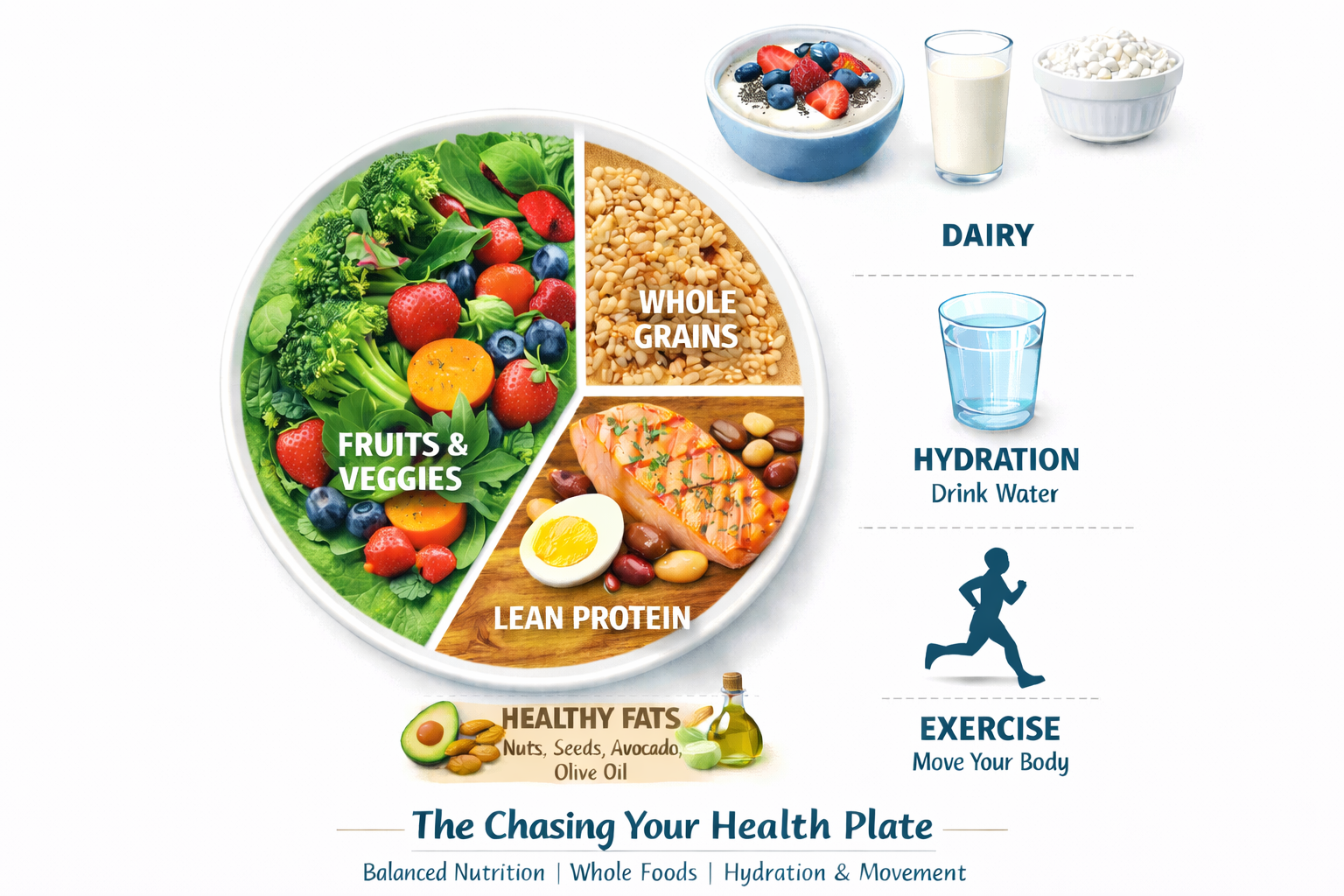
Create your meals based on the CYH Plate.
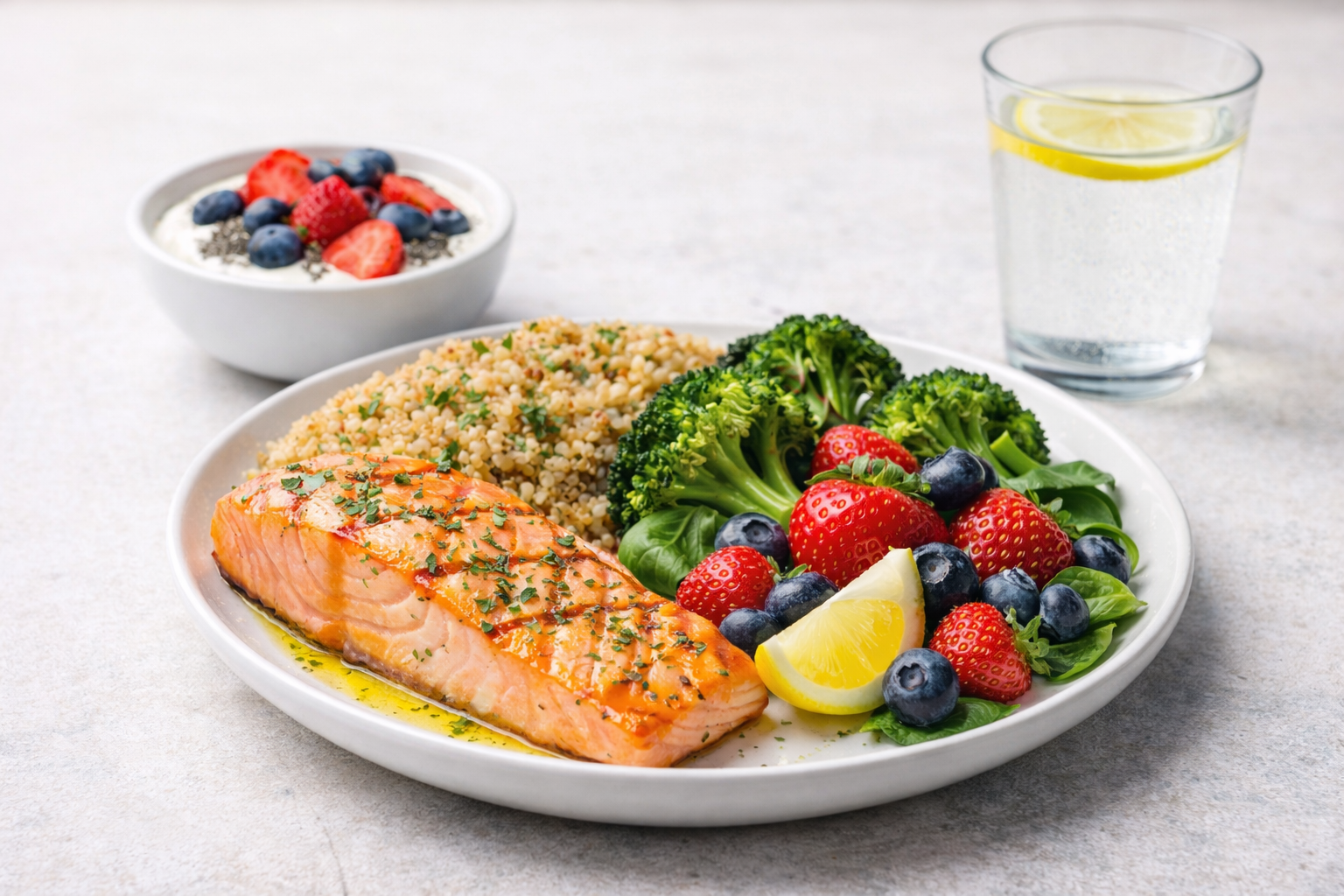
This is what I have envisioned for the Chasing Your Health Plate
Why the CYH Plate
One question I get a lot is why the Chasing Your Health plate uses roughly one-third protein, one-fourth grains, and one-half fruits and vegetables.
For me it’s simple: balance and function.
Each of those categories plays a different role in keeping your body running well. When you combine them, you create a meal that supports energy, satiety, metabolic health, and overall nutrition.
Protein: The Foundation
Protein takes up a third of the plate because most people simply aren’t getting enough of it consistently throughout the day.
Protein helps:
Preserve and build muscle
Support metabolism
Improve satiety (you stay fuller longer)
Stabilize blood sugar
Muscle is one of the most metabolically active tissues in the body, and maintaining it becomes even more important as we age. Prioritizing protein at meals helps support strength, metabolism, and long-term health.
Grains and Starches: Fuel for the Body
Carbohydrates often get unfairly villainized online, but they are your body’s preferred energy source.
Quality grains and starches provide:
Readily available fuel for your brain and muscles
Fiber that supports gut health
Nutrients like B vitamins, magnesium, and iron
Whole grains in particular feed beneficial gut bacteria, which produce compounds like short-chain fatty acids that support gut health and may help regulate inflammation and metabolic function.
In other words, carbs aren’t the enemy. They’re fuel.
Fruits and Vegetables: Nutrient Density
Fruits and vegetables round out the plate because they bring a lot to the table with relatively few calories.
They provide:
Fiber that supports digestion and gut health
Vitamins and minerals that support cellular function
Antioxidants that help manage oxidative stress
Volume that helps keep you satisfied
In practical terms, fruits and vegetables add nutrient density and fullness to meals without dramatically increasing calories.
Why Balance Matters
When meals include protein, carbohydrates, and plants together, a few important things happen:
Energy is more stable.
Hunger is better controlled.
Blood sugar tends to be more regulated.
Meals are more satisfying.
Instead of cutting entire food groups out or chasing the latest nutrition trend, this approach focuses on balance and consistency.
And in nutrition, boring and consistent tends to beat extreme every time.
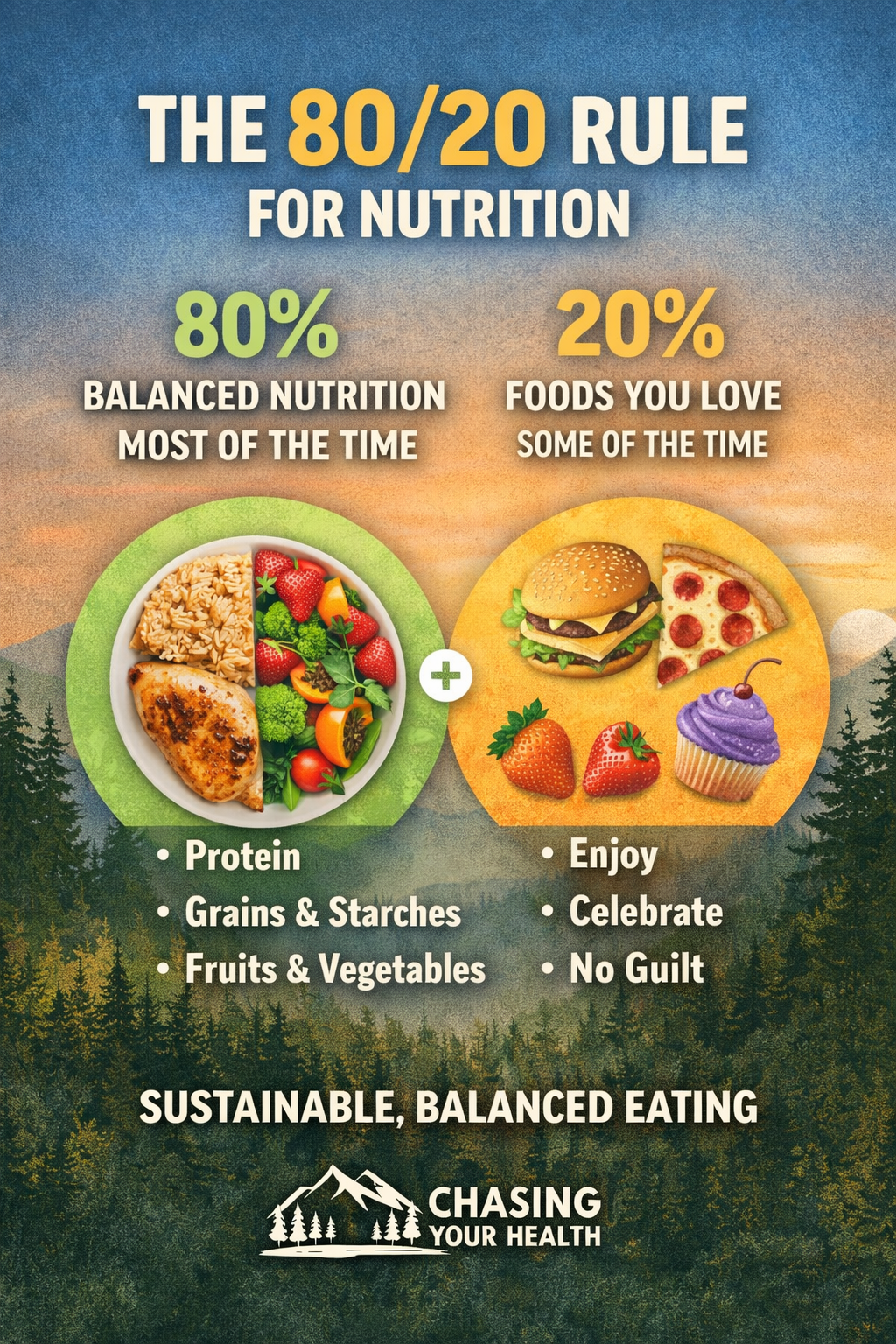
Aim to eat a well-balanced diet 80% of the time and the other 20%… enjoy the birthday cake. It’s all about moderation… not super restriction.
The 80/20 Rule: Why Perfection Isn’t the Goal
Another principle I encourage with nutrition is what many people call the 80/20 approach.
The idea is simple.
About 80% of the time, aim for balanced meals that include protein, grains or starches, fruits or vegetables, and healthy fats.
The other 20% of the time, enjoy the foods that make life enjoyable — pizza night, dessert, birthday cake, a beer with friends.
No guilt required.
Because nutrition isn’t determined by one meal.
It’s determined by the patterns you repeat over weeks, months, and years.
Is There Science Behind This?
Interestingly, research strongly supports the concept behind flexible eating patterns — even if scientists don’t literally call it the “80/20 rule.”
Nutrition researchers often describe this idea as flexible dietary restraint.
Studies comparing flexible versus rigid dieting approaches have found that people who allow occasional indulgences tend to have:
• Better long-term adherence to healthy habits
• A healthier relationship with food
• Lower risk of binge-restrict cycles
In contrast, highly rigid diets — the “never eat this,” “cut out that,” “start over Monday” approach — are more likely to lead to burnout and eventually abandoning the plan.
Research also consistently shows that adherence matters more than the specific diet itself.
In other words, the eating pattern you can maintain long-term is the one that actually improves health.
Health Is a Pattern, Not a Single Meal
One burger doesn’t ruin your health.
Just like one salad doesn’t fix everything.
What matters most is the overall pattern.
If most of your meals support your body with balanced nutrition, there is plenty of room for the foods that make life enjoyable.
Because food isn’t just nutrients.
It’s also:
• culture
• family
• celebration
• connection
And those things matter too.
Signs Your Health Is Actually Improving
Progress doesn’t always show up on the scale.
Sometimes it looks like:
More stable energy during the day
Fewer afternoon crashes
Better digestion
Stronger workouts
Improved lab numbers
Less obsession around food
More consistency with habits
Better mood and focus
Maybe your clothes fit better but the number on the scale didn’t change
Those are real wins.
Chase’s Final Thought
Healthy does not mean:
Perfect
Restrictive
Smaller at all costs
Healthy means your habits support your long-term function.
Healthy means your body works well.
Healthy means sustainable.
If we stop pretending health equals thinness, more people could actually achieve it.
And that would be wildly inconvenient for the detox industry.
-Chase M. MS, RDN, LN, CSR