

💉 GLP-1 Weight Loss: Are You Losing Fat or Muscle?
“You’re losing weight—but a meaningful portion might not be fat.”
Medications like Ozempic and Mounjaro were originally developed for diabetes, while Wegovy and Zepbound are approved specifically for weight loss.
And here’s where a lot of people get confused: 👉 They’re the same active medications—just branded and dosed differently for different purposes.
And to be clear—they work. People are losing weight. Blood sugars improve. Health markers move in the right direction.
But here’s the part most people aren’t being told: 💥 Weight loss is not the same as fat loss.
⚡ Quick Take
GLP-1s are highly effective for weight loss
~25–40% of that loss may come from lean mass
Lean mass includes more than muscle
Faster weight loss increases the need to protect muscle
Protein + resistance training are critical!!
The goal isn’t just weight loss—it’s what you lose
🧠 What GLP-1 Medications Actually Do
GLP-1 receptor agonists help regulate appetite and blood sugar.
They:
Slow gastric emptying
Reduce hunger
Improve glucose control
👉 Most people eat less → weight loss follows
That’s the primary driver.
⚠️ The Lean Mass Reality
Weight loss is rarely 100% fat.
Research consistently shows:
👉 ~25–40% of total weight loss may come from lean mass
For example:
Clinical trials on Wegovy have shown ~40% of weight loss from lean mass
Studies on Mounjaroshow a similar—though slightly lower—range
And this isn’t unique to these medications:
👉 Even traditional weight loss often includes 20–30% lean mass loss
💥 That’s not a small detail—that’s a major part of the outcome.
🧠 What “Lean Mass” Actually Means
When research reports “lean mass,” it includes:
Skeletal muscle
Organs
Body water
Glycogen (and the water stored with it)
Connective tissue
So when you hear: 👉 “25–40% lean mass loss”
That does not mean 25–40% muscle loss.
⚠️ So Are You Losing Muscle
Short answer: Yes—just not exclusively.
During weight loss:
Some muscle loss is expected
Some water and glycogen loss is expected
What matters is:
👉 How much muscle you lose relative to fat
💥 Lean mass loss is expected. Losing more muscle than necessary is not.
📊 What People Think vs Reality
Most people assume weight loss is almost all fat.
👉 That’s not how physiology works.
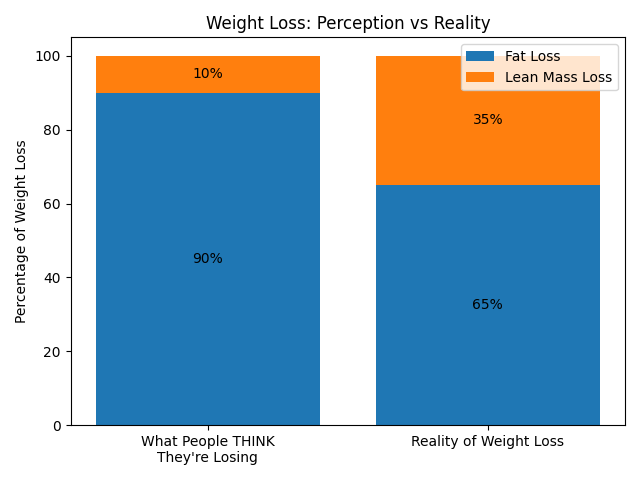
Left = common perception. Right = typical research range (~25–40% lean mass loss).
Illustrative comparison based on current evidence—not exact individual outcomes.
💥 This is why two people can lose the same weight—and end up with very different bodies.
🧠 Real-World Example
Think about someone who:
Eats 800–1,000 calories per day
Barely hits protein
Doesn’t strength train
👉 Where does the body pull energy from?
Not just fat.
💥 Without the right inputs, your body will break down muscle too.
🏋️ Why Muscle Still Matters
Muscle plays a major role in:
Metabolic rate
Strength
Physical function
Long-term weight maintenance
💥 You can lose weight and still move backward metabolically if too much muscle is lost.
📉 Why This Happens on GLP-1s
GLP-1s create a calorie deficit—but they also:
Suppress appetite significantly
Make under-eating easy
Often reduce total protein intake
Combine that with:
No resistance training
Rapid weight loss
👉 And the balance can shift toward more muscle loss than necessary
⚠️ The Better Question
Instead of asking: ❌ “How much weight will I lose?”
Ask: 👉 “What kind of weight am I losing?”
Because: 💥 Faster weight loss without a plan increases the risk of losing what actually matters.
🍗 How to Better Preserve Lean Mass
1. Prioritize Protein
Most research shows muscle-building benefits plateau around ~1.6 g/kg/day in ideal conditions.
But during weight loss:
👉 Higher protein intakes may help preserve lean mass
A practical range:
~1.2-1.6 g/kg/day (standard)
~1.6–2.2 g/kg/day (individualized)
Some people do need to do less protein, especially those with chronic kidney disease, always ask your doctor
2. Strength Train
At least:
2–3 times per week at least!
This is the primary signal your body uses to keep muscle.
3. Avoid Extreme Undereating
GLP-1s reduce hunger—but:
💥 Just because you can eat very little doesn’t mean you should. This can also hinder your weight loss long term by slowing down metabolism. Trust me your body views weight loss as a threat and will slow down metabolism in order to prevent it.
4. Track More Than the Scale
Pay attention to:
Strength
Energy
Function
👉 The scale doesn’t tell you what you’re losing
🔬 What’s Coming Next
GLP-1s are just the beginning.
Newer medications like Retatrutide are already in development—and they take things a step further.
Unlike current options, these target three pathways:
GLP-1 → reduces appetite
GIP → influences insulin and metabolic signaling
Glucagon → increases energy expenditure
👉 Translation: You’re not just eating less— you may also be burning more energy at the same time
⚡ Why This Matters
This shifts weight loss from:
👉 “calorie restriction”
to:
👉 “calorie restriction + increased energy output”
Early data suggests:
Greater total weight loss
More aggressive changes in energy balance
On paper, that sounds like a win.
But physiologically, it raises an important question:
⚠️ What Happens to Lean Mass?
When the body is in a larger energy deficit:
It needs more fuel
It pulls from available energy stores
And that includes both fat and lean tissue
💥 The larger the deficit, the more important it becomes to protect lean mass.
This isn’t unique to medications—it’s basic physiology.
But with more potent therapies:
👉 The rate and magnitude of weight loss may increase
👉 Which increases the risk of losing more lean mass without intervention
🧠 What We Know (and What We Don’t)
Right now:
Early trials show impressive weight loss outcomes
But long-term body composition data is still limited
So while the results are promising:
👉 We don’t yet fully understand:
How much lean mass is being lost
How sustainable those changes are
What happens over time without structured nutrition and training
💥 The Takeaway
These medications are becoming more powerful.
But the principle hasn’t changed:
👉 The more aggressive the weight loss,
👉 the more intentional you have to be about preserving muscle
👩⚕️ Where Dietitians Should Be Leading
Medications like:
Ozempic
Wegovy
Mounjaro
Retatrutide
👉 Are valuable tools—and for many people, appropriate.
This isn’t about denying their use.
But here’s the gap:
Rapid weight loss without structured nutrition
Minimal focus on preserving muscle
Little guidance on resistance training
💥 The Missing Piece
A prescription can initiate weight loss. Nutrition and training determine the outcome.
🧠 The Balanced Approach
Medication decisions belong to:
Physicians
Pharmacists
But once that decision is made:
👉 Nutrition support should be part of the plan—not an afterthought.
🏋️ The Real Goal
Not: ❌ Lose weight as fast as possible
But: ✅ Lose weight while maintaining:
Muscle
Strength
Function
Long-term sustainability
⚖️ Final Thoughts
We’ve gotten very good at helping people lose weight.
💥 Now we need to get just as good at helping them keep what matters.
Because health isn’t just about being smaller.
It’s about being:
Stronger
More functional
Sustainable
👨⚕️Chasing Your Health Professional Note
As a Registered Dietitian, my role is to translate evidence into practical strategies—not replace your healthcare provider.
If you’re using medications like Ozempic or Wegovy, work with your healthcare team to support both weight loss and lean mass preservation.
📣 Call to Action
👉 Share this with someone using a GLP-1
👉 Ask yourself: “What kind of weight am I losing?”
👉 Follow Chasing Your Health for more evidence-based nutrition from an actual dietitian
👉 Latest Blog Links Below: